
Oil Paint
Oil paint is a slow-drying art medium made with pigment and a drying-oil binder that allows extended working time, smooth blending, and layered application.
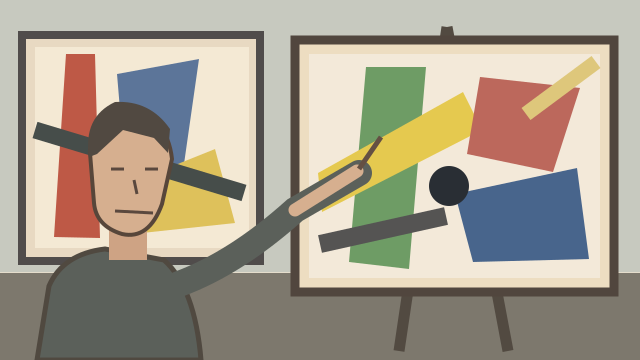
Painter
Olga Rozanova was a Russian avant-garde painter whose bold Suprematist compositions and pure-color experiments pushed abstraction beyond recognizable forms.
Rozanova moved from Cubo-Futurist experiments toward Suprematist geometry and her own direct approach to pure color.
| Born | 1886 · Melenki, Russian Empire (now Russia) |
|---|---|
| Died | 1918 · Moscow, Russia |
| Nationality | Russian |
| Movements | Suprematism; Russian Cubo-Futurism (earlier work) |
| Paint types | Oil Paint |
| Painting surfaces | Canvas |
| Painting methods | Nonrepresentational shapes, sharp color contrasts, isolated diagonals and rectangles, and increasingly reduced bands of color |
| Common subjects | Non-objective color, floating geometric forms, and, in her earlier work, figures and fragmented urban scenes |
| Notable works | Non-Objective Composition · Green Stripe (Diffused Light) · Man on the Street (Analysis of Volumes) |
| Other practice | Illustrated experimental poetry books and designed graphic compositions, separate from her documented painting media |
Sources: Museo Thyssen-Bornemisza: Olga Rozanova biography, State Russian Museum: Non-Objective Composition, oil on canvas, Rostov Kremlin Museum: Green Stripe, oil on canvas.
Rozanova's abstract oil paintings used vivid contrasting tones; collection records identify both Non-Objective Composition and Green Stripe as oil on canvas.
Oil paint is a slow-drying art medium made with pigment and a drying-oil binder that allows extended working time, smooth blending, and layered application.
The State Russian Museum and the Rostov Kremlin Museum document her major non-objective oil paintings on canvas.

Canvas is a woven fabric support, commonly cotton or linen, used for painting and sold either raw or prepared with a compatible ground layer.
Malevich worked with Rozanova in Suprematism; Mondrian later pursued a distinct form of geometric abstraction using strong contrasts.

Kazimir Malevich was a Kyiv-born avant-garde painter who founded Suprematism, reducing painting to geometric shapes, color, and the texture of oil on canvas.

Piet Mondrian was a Dutch abstract painter known for balanced compositions of straight black lines, rectangular color planes, and white space.