
Vincent van Gogh
Vincent van Gogh was a Dutch Post-Impressionist painter known for expressive color, energetic brushwork, and a highly visible paint surface.
Painting Surface
Canvas is a woven fabric support, commonly cotton or linen, used for painting and sold either raw or prepared with a compatible ground layer.
Canvas works well with acrylic and oil paint when properly prepared, while watercolor, gouache, markers, and specialty coatings may need a suitable ground or medium.
| Paint | Compatibility | Preparation | Primer or ground | Finish | Guide |
|---|---|---|---|---|---|
| Acrylic paint | Excellent | Pre-primed canvas can usually be painted directly; raw canvas should be properly prepared. | Gesso for raw canvas. | Optional varnish. | — |
| Acrylic gouache | Excellent on properly prepared canvas | Use clean, dry, properly primed canvas. | Artist acrylic gesso or another compatible acrylic ground on raw canvas. | Flat matte and permanent when dry; optional compatible varnish may alter the surface appearance. | — |
| Fluorescent paint | Excellent with fluorescent acrylic paint | Use clean, dry, properly prepared canvas. | Artist acrylic gesso; a white ground usually gives the strongest fluorescent effect. | Use a compatible varnish only when needed, understanding that any finish can affect appearance. | — |
| Iridescent paint | Excellent on properly prepared artist canvas | Use clean, dry, properly primed canvas. | Artist acrylic gesso or another compatible acrylic ground on raw canvas. | The visible luster depends on pigment, base color, viewing angle, and any final varnish or medium. | — |
| Oil paint | Excellent | Use oil-ready pre-primed canvas or size raw canvas before applying a suitable ground. | Artist acrylic gesso or oil ground. | Optional final varnish. | — |
| Paint markers | Excellent with compatible artist paint markers | Use properly primed, clean, dry canvas. | Use the canvas ground already required by the support. | Usually optional; use a compatible varnish when additional protection is needed. | — |
| Leather paint | Good on wearable or craft canvas when the system is adapted for woven fabric | Use clean, dry canvas and support thin fabric while painting to reduce movement and bleed-through. | Use the manufacturer's fabric medium when required to keep the coating soft and flexible. | Heat-set or cure the paint-medium system exactly as directed before regular use. | — |
| Watercolor paint | Good with watercolor-specific preparation | Start with clean, dry, primed canvas and follow the preparation product's coating and drying directions. | Apply a watercolor ground or multi-surface watercolor preparation. | Protect from moisture and abrasion using a display method suited to watercolor. | — |
| Gouache paint | Good when the product approves canvas | Use clean, dry, prepared canvas and avoid heavy paint buildup that may crack as the support flexes. | Use a suitable absorbent ground when required. | Keep dry and protect from abrasion; traditional gouache remains water-sensitive. | — |
| Chalk paint | Good for decorative projects | Use clean, dry canvas and test flexibility for the intended use. | Usually not required on prepared artist canvas. | Product-specific. | — |
Sources: Angelus canvas painting guidance, Winsor & Newton Multi-Surface Preparation, Talens Art Creation Gouache, Liquitex surface preparation, POSCA canvas guidance, Gamblin sizes and grounds, Liquitex BASICS Fluorescent Yellow, and Golden High Flow Acrylic Colors.
Browse PaintZeal painter profiles featuring artists who worked on canvas, with examples of traditional painting, mixed media, layered surfaces, and varied materials.
Vincent van Gogh was a Dutch Post-Impressionist painter known for expressive color, energetic brushwork, and a highly visible paint surface.

Claude Monet was a French Impressionist painter known for landscapes and repeated studies of changing light, color, and atmosphere.
Bob Ross was an American painter, art instructor, and television host best known for The Joy of Painting and his approachable wet-on-wet oil-painting lessons.

Pablo Picasso was a Spanish artist whose long career moved through many styles and media, from the Blue and Rose periods to Cubism, classicism, Surrealism, sculpture, printmaking, and ceramics.

Andy Warhol was an American Pop artist known for transforming consumer products, celebrities, and mass-media photographs into paintings and repeated screen-printed images.

Frida Kahlo was a Mexican painter known for psychologically intense self-portraits and paintings exploring identity, family, physical pain, relationships, and Mexican culture.

Georgia O'Keeffe was an American modernist known for close-up flowers, New Mexico landscapes, bones, architecture, and simplified natural forms.

David Hockney was a British artist known for vivid portraits, landscapes, and California swimming-pool scenes, as well as decades of experimentation with printmaking, photography, and digital drawing.

J. M. W. Turner was a British Romantic artist known for luminous landscapes, turbulent seas, dramatic weather, and increasingly expressive treatments of light and color.
Henri Matisse was a French artist known for vivid color, simplified forms, Fauvist painting, and the gouache-painted paper cut-outs of his later career.

Edgar Degas was a French artist associated with the Impressionists who became known for ballet dancers, horse racing, portraits, and carefully observed scenes of modern Parisian life.
Jackson Pollock was an American Abstract Expressionist known for pouring, dripping, and flinging fluid paint across canvases laid on the floor.

Abraham Joel Tobias was an American painter, muralist, and educator whose experiments with durable materials included pioneering use of ethyl silicate paint as a permanent medium for outdoor murals.

Ashley Longshore is an American contemporary painter, sculptor, and entrepreneur known for brightly colored Pop-inspired work combining celebrity imagery, fashion, text, humor, feminism, and consumer culture.

Bridget Riley is a British painter known for tightly controlled abstract compositions that create optical movement through repeated lines, curves, shapes, and carefully calibrated color relationships.

Chéri Samba is a Congolese painter known for vivid narrative scenes that combine figures, written text, autobiography, humor, and social commentary. MoMA documents his use of alkyd enamel paint in major canvas works.

Cy Twombly was an American painter known for spare, gestural works that often combined oil-based house paint with crayon, pencil, and other drawing materials.
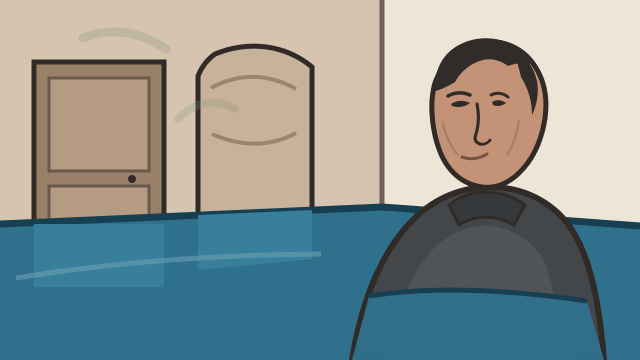
Davide D'Elia is an Italian artist whose work explores time, material change, and preservation. He is known for partially covering furniture, fabrics, pictures, and other existing objects with blue antifouling paint normally used to protect boat hulls.

Devon Rodriguez is an American portrait painter from the South Bronx known for realistic paintings and drawings of New York City subway riders and for sharing his portrait process with a large social-media audience.

Dia al-Azzawi is an Iraqi artist whose wide-ranging practice combines modern painting and drawing with imagery rooted in the ancient art and literature of Iraq. The Metropolitan Museum of Art documents metallic paint throughout his 1965–67 Studies for The Epic of Gilgamesh.

Édouard Vuillard was a French painter known for intimate interiors, gardens, patterned surfaces, and decorative compositions in distemper, oil, and other media.

Edward Hopper was an American realist known for quiet city interiors, roadside buildings, coastal landscapes, and scenes shaped by strong light, geometry, and psychological distance.

Frank Stella was an American artist whose abstract paintings repeatedly crossed into industrial paint chemistry, including alkyd enamel, epoxy paint, urethane enamel, fluorescent color, synthetic polymer paint, and copper antifouling paint.

Helen Frankenthaler was an American painter whose soak-stain technique helped reshape postwar abstraction by allowing thinned paint to soak directly into raw canvas.

Jacqueline Humphries is an American abstract painter known for reflective silver surfaces that shift with movement and light, combining metallic effects with layered, scraped, and gestural paint.
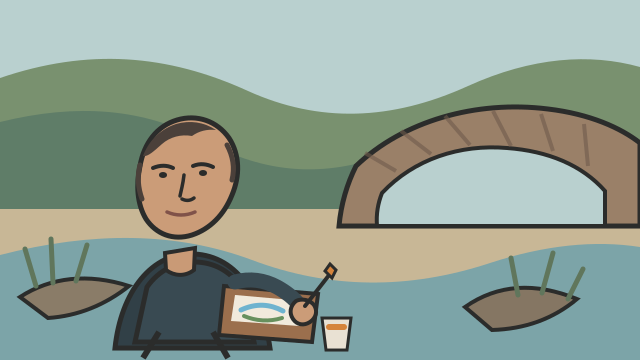
James Gurney is an American painter, illustrator, and author known for imaginative realism, outdoor sketching, and extensive work in casein, gouache, watercolor, and oil.

Jasper Johns is an American artist known for turning familiar symbols such as flags, targets, numbers, and maps into tactile paintings and objects that question how images are seen and understood.

Jean Dubuffet was a French painter and sculptor who challenged conventional ideas of artistic refinement through rough surfaces, unruly figures, unconventional materials, and a long-running interest in Art Brut.

Jean-Michel Basquiat was an American artist whose paintings combined intense color, handwritten text, anatomy, crowns, cultural references, music, history, and the energy of New York street culture.
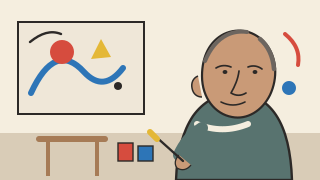
Joan Miró was a Spanish artist known for poetic symbols, biomorphic forms, vivid color, playful abstraction, and a highly personal visual language associated with Surrealism.

Keith Haring was an American artist known for energetic outlined figures, public murals, subway drawings, vivid color, and an instantly recognizable visual language used to address social and political themes.

Konrad Lueg was a German painter who experimented with popular imagery, repeated patterns, and phosphorescent color that allowed viewers to cast temporary shadows onto luminous canvases.
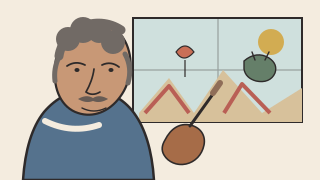
Marc Chagall was a Belarus-born French artist known for dreamlike scenes combining village memories, lovers, animals, folklore, religion, music, and vivid color.

Mary Corse is an American painter known for luminous white paintings that combine acrylic paint with reflective glass microspheres so the surface changes with light and the viewer's position.

Molly Zuckerman-Hartung is an American painter known for materially experimental abstraction that can combine latex house paint, enamel, spray paint, cut and sewn drop cloth, and other everyday studio materials.

Paul Klee was a Swiss-born German artist and Bauhaus teacher whose highly experimental work combined color, geometry, symbols, humor, music, and observations of nature.

Peter Halley is an American painter known for geometric images of cells, prisons, and conduits built from fluorescent Day-Glo acrylic color and deliberately artificial commercial textures.

Reginald Marsh was an American painter and illustrator known for energetic scenes of New York City crowds, Coney Island, burlesque theaters, and street life.
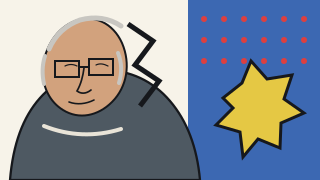
Roy Lichtenstein was an American Pop artist known for enlarging comic-book and advertising imagery into carefully constructed paintings using bold outlines, flat color, and patterns inspired by commercial printing.

Sandro Botticelli was a Florentine Renaissance painter known for elegant line, graceful figures, religious paintings, portraits, and mythological works including The Birth of Venus and Primavera.

Sarah Kraning is an American painter with auditory-visual synesthesia who translates music into color, texture, and movement, creating abstract paintings that function as visual responses to songs and live performances.

Sidney Nolan was an Australian painter whose early work made extensive use of fluid, fast-drying commercial enamel paint, especially Ripolin, to build stark figures and landscapes with unusually direct color.

Slawn, born Olaolu Akeredolu-Ale, is a Nigerian-born contemporary artist known for raw, graphic paintings that combine street-art energy, recurring caricatured faces, Yoruba identity, humor, and social commentary.

Sophie Tea is a contemporary painter known for vivid color, energetic drips and splats, abstract work, and body-positive paintings celebrating the female form. Her career has been built largely through direct online audiences and social media.

Suzanne McClelland is a New York-based artist known for abstract paintings built from language, numbers, gesture, and shifting surface effects that include iridescent paint.
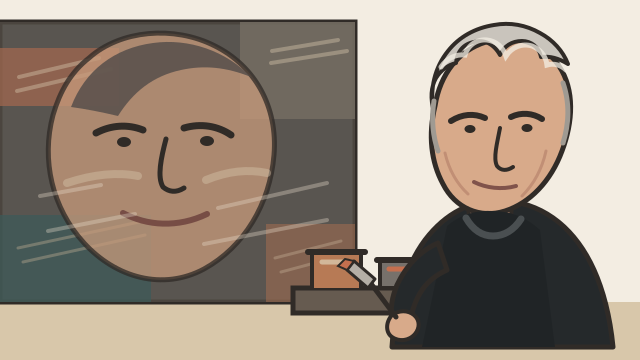
Tony Scherman is a Canadian painter known for figurative and historical paintings made with encaustic, an uncommon wax-and-pigment medium he has used for decades.

Tschabalala Self is an American artist known for layered figurative paintings that combine painted and sewn materials. Her 2018 painting Lite includes acrylic, Flashe, milk paint, fabric, and gum on canvas.

Ushio Shinohara is a Japanese artist known for energetic action-based painting, Neo-Dada and Pop experimentation, and works using fluorescent Day-Glo color, lacquer, and unconventional materials.

Wassily Kandinsky was a Russian-born painter, teacher, and theorist who became a major pioneer of abstract art and explored how color, line, shape, and rhythm could convey emotion without relying on recognizable subjects.
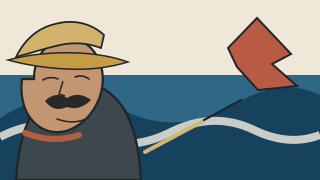
Winslow Homer was an American painter and illustrator known for direct, powerful scenes of the sea, coastal life, rural America, and people confronting the forces of nature.

Yayoi Kusama is a Japanese contemporary artist known for repeated dots and nets, large-scale installations, mirrored environments, sculpture, and paintings centered on ideas of infinity and self-obliteration.

Yuval Gur is an Israeli composer and artist whose Tfila series turns paintings into interactive musical surfaces. He created his own conductive paint, uses it as a proximity sensor beneath oil paint, and maps different painted areas to pre-composed music.
No related PaintZeal articles are currently available.