
Oil Paint
Oil paint is a slow-drying art medium made with pigment and a drying-oil binder that allows extended working time, smooth blending, and layered application.
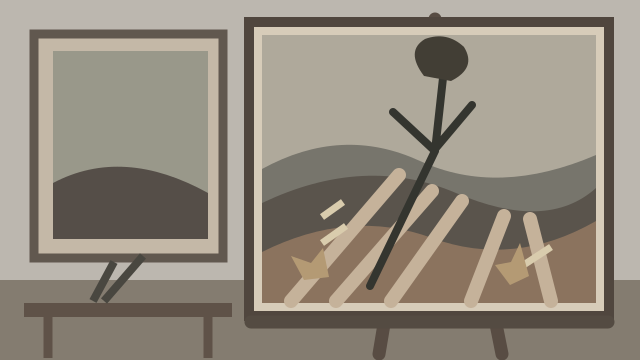
Painter
Anselm Kiefer is a German painter and sculptor known for monumental, heavily layered images of landscapes, history, literature, and memory using paint alongside straw, lead, and other materials.
Kiefer's painted surfaces often contain non-paint materials as integral parts of the work. Straw, metal sheets, shellac, charcoal and photographs have different functions from oil or acrylic paint, and individual works use distinct combinations.
| Born | 1945 · Donaueschingen, Germany |
|---|---|
| Died | — |
| Nationality | German |
| Movements | Neo-Expressionism (associated German context); postwar German art |
| Paint types | Oil paint · acrylic paint · watercolor · gouache; emulsion, shellac, powdered pigment, and other materials in specific works |
| Painting surfaces | Canvas · linen · paper; also burlap (coarse woven jute) in specific paintings |
| Painting methods | Built dense, weathered surfaces from layered paint, shellac and emulsion, incorporating straw, lead, charcoal, or photographs; also made watercolor-and-gouache studies |
| Common subjects | German history, memory of war, mythology, poetry, burned fields, architecture, forests, sunflowers, and allegory |
| Notable works | Sulamith (1983) · Böhmen liegt am Meer (Bohemia Lies by the Sea) (1996) · Die Milchstraße (The Milky Way) (1985–87) |
Sources: SFMOMA: Sulamith (1983), The Met: Bohemia Lies by the Sea, Ashmolean: paintings and works on paper, Saint Louis Art Museum: mixed-media works, National Gallery of Art: Zim Zum.
SFMOMA records Sulamith as oil, acrylic, emulsion and shellac with a woodcut and straw on linen. The Met records oil and other substances on burlap in Bohemia Lies by the Sea. The Ashmolean documents separate watercolor-and-gouache works on paper. Shellac, lead, and straw should not be treated as standalone paint types.
Oil paint is a slow-drying art medium made with pigment and a drying-oil binder that allows extended working time, smooth blending, and layered application.
Acrylic paint is a fast-drying, water-based paint made with pigment and an acrylic polymer binder that forms a durable film on many prepared surfaces.

Watercolor paint is a water-based art medium made with pigment and a water-soluble binder, typically applied in transparent washes on absorbent paper.

Gouache paint is an opaque, water-based art medium made with pigment and a water-soluble binder, drying to a matte finish that can be reactivated with water.
Kiefer's large paintings use fabric supports, including linen and burlap; paint-bearing photographs mounted on canvas and mixed-media works with applied metal also exist. His works on paper are separate smaller pieces. The surface tile for canvas refers to documented canvas-backed works, not every burlap painting.

Canvas is a woven fabric support, commonly cotton or linen, used for painting and sold either raw or prepared with a compatible ground layer.

Linen is a strong woven fabric made from flax fibers and widely used for fine-art painting, with artist linen sold either raw or prepared with a ground layer.

Paper is an absorbent sheet material made from pressed fibers, with weight, sizing, and surface texture controlling moisture tolerance and paint behavior.
Schnabel likewise challenges the flat painted surface with attached matter, while Basquiat represents a different, distinctly New York approach to expressive imagery and cultural memory.
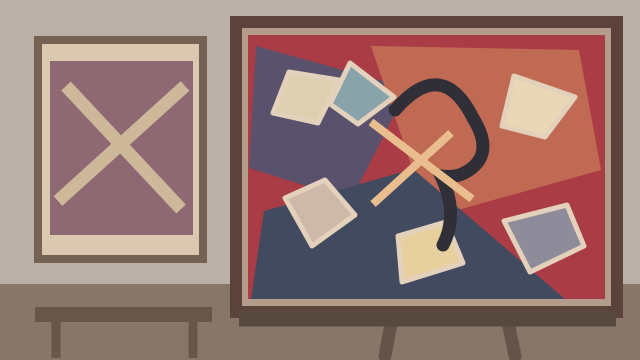
Julian Schnabel is an American painter and filmmaker associated with Neo-Expressionism, known for monumental paintings that incorporate broken ceramic plates, thick brushwork, and unusual supports.
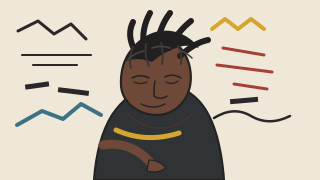
Jean-Michel Basquiat was an American artist known for paintings combining color, handwritten text, anatomy, crowns, cultural references, music, and history.