
Oil Paint
Oil paint is a slow-drying paint made with pigment and a drying oil binder. It is widely used for artwork because it blends smoothly and develops rich color.
Painting Movement
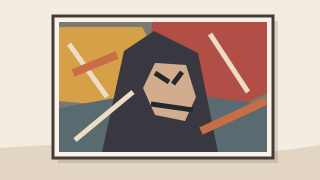
Neo-Expressionism revived large, emotionally charged painting in the late 1970s and 1980s, often combining rough gestures with figurative imagery.
Neo-Expressionism revived large-scale, expressive painting in the late 1970s and 1980s, often combining assertive brushwork with figures and historical imagery.
| Origin | Multiple centers, including West Germany, Italy, and the United States |
|---|---|
| Approximate period | Late 1970s–1980s (with later influence) |
| Other names | Neo-expressionist painting; Neue Wilde and Transavanguardia are related regional contexts, not exact synonyms |
| Defining features | Forceful brushwork, exaggerated figures, high contrast, layered images, and historical or cultural references |
| Historical context | A renewed focus on painting following the prominence of Minimalism and Conceptual art |
| Associated painters | Jean-Michel Basquiat, Julian Schnabel, Anselm Kiefer, Francesco Clemente; Georg Baselitz was an important earlier influence |
| Representative work | Julian Schnabel's Bones and Trumpets Rubbing Against Each Other Towards Infinity (1981) |
| Techniques and paint | Oil, acrylic, mixed media, heavy layering, and sometimes nontraditional materials |
| Supports | Canvas and wood, including assemblage-like painted surfaces |
Sources: The Met: Schnabel's 1981 painting, Guggenheim: Julian Schnabel, Whitney: Painting from the 1980s.
Oil and acrylic offer broad brushwork and visible layers; spray and industrial coatings suit some mixed-media interpretations, while gouache and tempera work for bold studies.
Oil paint is a slow-drying paint made with pigment and a drying oil binder. It is widely used for artwork because it blends smoothly and develops rich color.

Acrylic paint is a fast-drying, water-based paint made with pigment and an acrylic polymer binder. It is widely used in art and decorative projects because it is versatile and durable.

Enamel paint is a broad category of coatings designed to form a hard and durable finish. Modern enamels may use either oil-based or water-based binders.

Spray paint is a liquid coating packaged in a pressurized can and applied as a fine aerosol. It creates an even finish without requiring a brush or roller.

Alkyd paint is a resin-based coating that levels into a smooth, durable finish. It is available in traditional solvent-based formulas and newer waterborne versions.

Gouache paint is an opaque, water-based art medium made with pigment and a water-soluble binder. Traditional formulas dry to a matte finish and can be reactivated with water.
Modern tempera is an opaque, water-based art paint used for school and craft projects, drying quickly and differing from traditional egg tempera.
These artists did not belong to a single formal group and differed greatly in subjects, materials, and cultural influences.

Jean-Michel Basquiat was an American artist known for paintings combining color, handwritten text, anatomy, crowns, cultural references, music, and history.
| Painter | Contribution |
|---|---|
| Julian Schnabel | Monumental figurative compositions and distinctive paintings incorporating broken crockery |
| Anselm Kiefer | Large layered German paintings exploring landscape, memory, and history |
| Francesco Clemente | An Italian Transavanguardia painter working with expressive figures and symbolism |
Neo-Expressionism drew from early Expressionism and the gestures of Abstract Expressionism while returning frequently to recognizable figures and references.
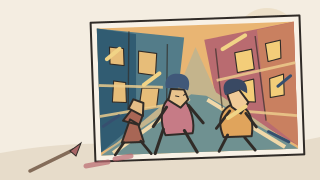
Expressionism grew in early twentieth-century Germany and Austria, using distorted forms, intense color, and bold compositions to express emotional experience.
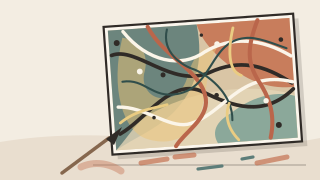
Abstract Expressionism emerged in postwar New York, where painters explored bold gestures, large canvases, and expansive fields of color.

Pop Art drew on advertising, comic books, celebrities, and everyday products, bringing mass-media imagery into painting in Britain and the United States.