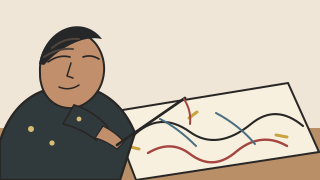
Jackson Pollock
Jackson Pollock was an American Abstract Expressionist known for pouring, dripping, and flinging fluid paint across canvases laid on the floor.
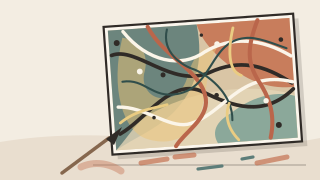
Painting Movement
Abstract Expressionism emerged in postwar New York, where painters explored bold gestures, large canvases, and expansive fields of color.
Compare Abstract Expressionism's origins, materials, gestures, and major approaches, including action painting and Color Field painting.
| Origin | New York City, United States, after World War II |
|---|---|
| Approximate period | 1940s–1950s |
| Associated school | New York School |
| Defining characteristics | Large-scale canvases, abstraction, expressive gestures, and fields of color |
| Major approaches | Action painting and Color Field painting; not every artist worked in the same style |
| Painting methods | Dripping, pouring, staining, gestural brushwork, and painting on floor-laid canvases |
| Paint types | Oil paint, enamel paint, and acrylic paint, depending on the artist |
| Painting surfaces | Canvas, sometimes unprimed or unstretched |
| Representative works | Pollock's One: Number 31, 1950 and Frankenthaler's Mountains and Sea |
Sources: MoMA: Abstract Expressionism, MoMA: Processes and materials, and National Gallery of Australia: Helen Frankenthaler.
Explore Pollock's poured paint, Frankenthaler's stained canvases, and Twombly's distinctive work at the edges of the New York School.
Jackson Pollock was an American Abstract Expressionist known for pouring, dripping, and flinging fluid paint across canvases laid on the floor.

Helen Frankenthaler was an American painter whose soak-stain technique helped reshape postwar abstraction by allowing thinned paint to soak directly into raw canvas.

Cy Twombly was an American painter known for gestural works that often combined oil-based house paint with crayon, pencil, and other drawing materials.
Twombly was associated with the New York School but developed a distinct visual language. Source: Whitney Museum of American Art.
Compare Abstract Expressionism with Pop Art's borrowed imagery and with Color Field painting's emphasis on broad areas of color.
| Movement or approach | How it relates |
|---|---|
| Pop Art | Often draws on consumer goods, comics, and mass media instead of emphasizing personal gesture and abstraction. |
| Color Field painting | A related strand of postwar abstraction emphasizing large areas of color, usually without a pronounced focal point. |
Sources: MoMA: Pop Art and MoMA: Color Field painting.