Enamel Paint
Enamel paint is a broad category of coatings designed to form a hard and durable finish. Modern enamels may use either oil-based or water-based binders.
Painter
Jackson Pollock was an American Abstract Expressionist known for pouring, dripping, and flinging fluid paint across canvases laid on the floor.
Before developing his drip paintings, Pollock explored Surrealism, especially its ideas about the unconscious and automatic painting.
| Born | January 28, 1912 · Cody, Wyoming, U.S. |
|---|---|
| Died | August 11, 1956 · Springs, New York, U.S. |
| Nationality | American |
| Movements | Abstract Expressionism |
| Paint types | Enamel paint · Oil paint · Metallic aluminum paint · Watercolor · Gouache |
| Painting surfaces | Canvas · Paper · Wood · Metal · Painting board · Cardboard |
| Painting methods | Pouring, dripping, flinging, brushing, and squeezing paint onto canvas |
| Common subjects | Abstract fields, rhythmic lines, movement, mythic figures, and landscape associations |
| Notable works | Number 1A, 1948, One: Number 31, 1950, Autumn Rhythm (Number 30), and Blue Poles |
Sources: MoMA: Number 1A, 1948, MoMA conservation project, MoMA: Pollock materials and process, The Met: Untitled (ca. 1938–41), and LACMA: No. 15, 1950.
See the paint types documented in Pollock's work, with links to PaintZeal references explaining each medium's properties, uses, and working characteristics.
Enamel paint is a broad category of coatings designed to form a hard and durable finish. Modern enamels may use either oil-based or water-based binders.

Oil paint is a slow-drying paint made with pigment and a drying oil binder. It is widely used for artwork because it blends smoothly and develops rich color.

Metallic paint contains reflective particles that create a metal-like shimmer or sheen. Products range from decorative water-based wall paints to specialty coatings and aerosols, so surface preparation and durability depend on the exact formula.
Watercolor paint is a water-based art medium made with pigment and a water-soluble binder. It is known for transparent color that settles into absorbent paper.
Gouache paint is an opaque, water-based art medium made with pigment and a water-soluble binder. Traditional formulas dry to a matte finish and can be reactivated with water.
See the surface types documented in Pollock's work, with links to PaintZeal references explaining how each support behaves and is prepared for painting.
Canvas is a woven fabric support used for paintings, banners, bags, décor, and other projects. Artist canvas may be raw, sized, acrylic-primed, oil-primed, or factory-coated, and each condition changes how paint absorbs and bonds.

Paper is an absorbent sheet material made primarily from cellulose fibers. Its weight, sizing, surface texture, and wet strength determine how much paint it can accept before buckling, pilling, bleeding, or warping.

Cardboard is a paper-based sheet material made from compressed fibers, often with corrugated fluting between liner sheets. It is lightweight and absorbent, so heavy wet coats can soften or warp it.
Wood is a natural, porous material with grain patterns and absorbency that vary by species and cut. Its surface may also contain knots, resin, or an existing finish.
Metal is a hard, nonporous material used in furniture, fixtures, equipment, vehicles, and architectural components. Its smooth surface gives ordinary paint little mechanical grip, and bare iron or steel can also corrode beneath a weak coating system.

Painting board is a rigid artist support made from hardboard, wood, or another stable panel material. It may be sold raw or prepared with a medium-specific ground layer.
Explore painters similar to Jackson Pollock through gestural abstraction, unconventional paint handling, fluid application, and physically direct working methods.

Helen Frankenthaler was an American painter whose soak-stain technique helped reshape postwar abstraction by allowing thinned paint to soak directly into raw canvas.
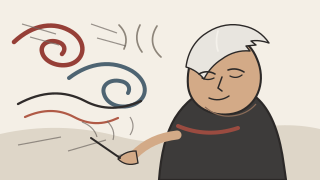
Cy Twombly was an American painter known for gestural works that often combined oil-based house paint with crayon, pencil, and other drawing materials.
Mark Tobey was an American painter known for abstract compositions built from dense networks of gestural marks and for working in casein, tempera, gouache, watercolor, and other media.