
Albrecht Dürer
Albrecht Dürer was a German Renaissance artist whose precise watercolors, drawings, engravings, and woodcuts combined close observation with exceptional technical control.
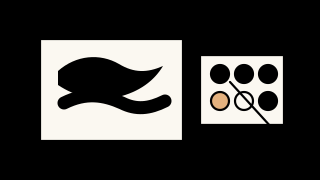
Paint Type
Watercolor paint is a water-based art medium made with pigment and a water-soluble binder, typically applied in transparent washes on absorbent paper.
Watercolor paint works naturally on absorbent paper, while less absorbent supports usually need a watercolor ground or other suitable preparation.
| Surface | Compatibility | Preparation | Primer or ground | Finish | Guide |
|---|---|---|---|---|---|
| Paper | Excellent on watercolor paper | Choose paper with enough weight and sizing for the amount of water; stretch lighter sheets when needed to reduce buckling. | Usually not required on watercolor paper. | Normally displayed behind glazing rather than varnished. | — |
| Air-Dry Clay | Good for transparent decorative effects | Use thoroughly dry clay and test first because porous clay can absorb washes quickly and unevenly. | Usually not needed when absorbency is part of the desired effect; sealing first changes how the wash behaves. | Use a compatible protective finish if the piece will be handled or may encounter moisture. | — |
| Canvas | Good with watercolor-specific preparation | Start with clean, dry, primed canvas and follow the preparation product's coating and drying directions. | Apply a watercolor ground or multi-surface watercolor preparation. | Protect from moisture and abrasion using a display method suited to watercolor. | — |
| Wood | Good with watercolor-specific preparation | Use clean, dry, stable wood and smooth rough areas before applying the preparation. | Apply a watercolor ground or multi-surface watercolor preparation. | Protect from moisture and handling using a method compatible with the preparation and paint. | — |
Sources: Winsor & Newton watercolor guidance, Winsor & Newton Multi-Surface Preparation, Crayola air-dry clay decorating guidance, and The Met watercolor overview.
Browse PaintZeal painter profiles featuring artists who used watercolor, with attention to paper, washes, layering, and other working methods.
Albrecht Dürer was a German Renaissance artist whose precise watercolors, drawings, engravings, and woodcuts combined close observation with exceptional technical control.
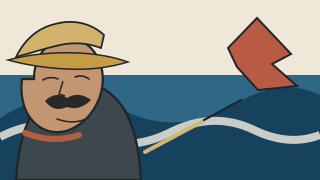
Winslow Homer was an American painter and illustrator known for direct, powerful scenes of the sea, coastal life, rural America, and people confronting the forces of nature.

Paul Klee was a Swiss-born German artist and Bauhaus teacher whose highly experimental work combined color, geometry, symbols, humor, music, and observations of nature.

Yayoi Kusama is a Japanese contemporary artist known for repeated dots and nets, large-scale installations, mirrored environments, sculpture, and paintings centered on ideas of infinity and self-obliteration.
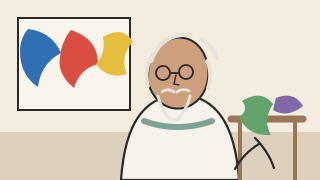
Henri Matisse was a French artist known for vivid color, simplified forms, Fauvist painting, and the gouache-painted paper cut-outs of his later career.

Georgia O'Keeffe was an American modernist known for close-up flowers, New Mexico landscapes, bones, architecture, and simplified natural forms.
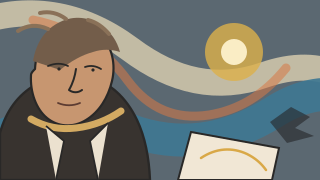
J. M. W. Turner was a British Romantic artist known for luminous landscapes, turbulent seas, dramatic weather, and increasingly expressive treatments of light and color.
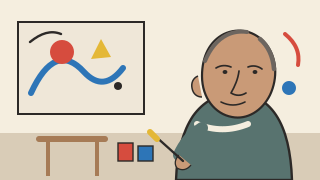
Joan Miró was a Spanish artist known for poetic symbols, biomorphic forms, vivid color, playful abstraction, and a highly personal visual language associated with Surrealism.

Edgar Degas was a French artist associated with the Impressionists who became known for ballet dancers, horse racing, portraits, and carefully observed scenes of modern Parisian life.
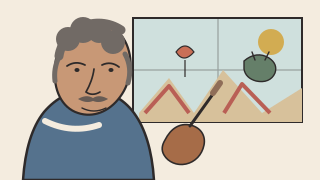
Marc Chagall was a Belarus-born French artist known for dreamlike scenes combining village memories, lovers, animals, folklore, religion, music, and vivid color.

Edward Hopper was an American realist known for quiet city interiors, roadside buildings, coastal landscapes, and scenes shaped by strong light, geometry, and psychological distance.
Andrew Wyeth was an American painter known for closely observed landscapes, interiors, and people from Chadds Ford, Pennsylvania, and coastal Maine.

Wassily Kandinsky was a Russian-born painter, teacher, and theorist who became a major pioneer of abstract art and explored how color, line, shape, and rhythm could convey emotion without relying on recognizable subjects.

Pablo Picasso was a Spanish artist whose long career moved through many styles and media, from the Blue and Rose periods to Cubism, classicism, Surrealism, sculpture, printmaking, and ceramics.
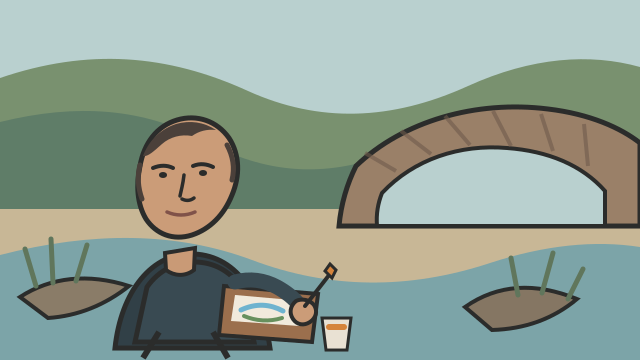
James Gurney is an American painter, illustrator, and author known for imaginative realism, outdoor sketching, and extensive work in casein, gouache, watercolor, and oil.
Raqib Shaw is an Indian painter known for densely detailed, jewel-like scenes made with industrial enamel, raised acrylic liner, and painstaking techniques that transform Old Master references into elaborate personal worlds.

Vincent van Gogh was a Dutch Post-Impressionist painter known for expressive color, energetic brushwork, and a highly visible paint surface.
No related PaintZeal articles are currently available.