
Oil Paint
Oil paint is a slow-drying art medium made with pigment and a drying-oil binder that allows extended working time, smooth blending, and layered application.
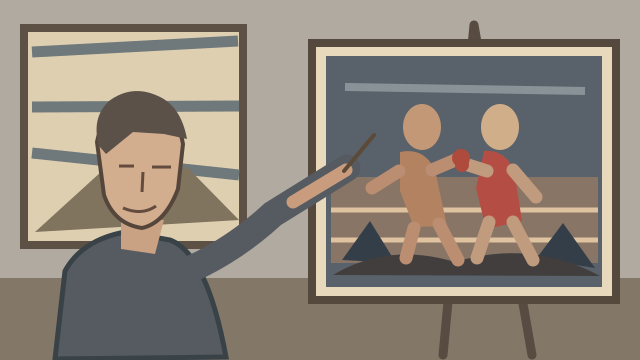
Painter
George Bellows was an American Ashcan School painter known for energetic scenes of New York City, boxing matches, crowded streets, and rough seas.
Bellows studied with Robert Henri, joined the Ashcan circle, and painted scenes of urban life with bold strokes and an unusually wide range of subjects.
| Born | 1882 · Columbus, Ohio, United States |
|---|---|
| Died | 1925 · New York City, United States |
| Nationality | American |
| Movements | Ashcan School; American Realism |
| Paint types | Oil Paint · Watercolor Paint |
| Painting surfaces | Canvas · Wood · Paper |
| Painting methods | Broad wet-into-wet oil brushwork and thick paint on canvas or wood; detailed watercolor-and-ink studies of urban scenes |
| Common subjects | Tenements, New York streets, boxing matches, harbor crowds, portraits, and crashing surf |
| Notable works | Stag at Sharkey's · Cliff Dwellers · Dempsey and Firpo · New York |
| Working approach | Some oil paintings were made directly on the support without preparatory sketches |
Sources: The Met: George Bellows exhibition and oil-paint technique, The Met: The Ashcan School, National Gallery of Art: George Bellows, Smithsonian: George Bellows.
Bellows painted city scenes, boxing, and seascapes in oil, sometimes applying colors wet-into-wet; watercolor appears in his urban studies.
Oil paint is a slow-drying art medium made with pigment and a drying-oil binder that allows extended working time, smooth blending, and layered application.

Watercolor paint is a water-based art medium made with pigment and a water-soluble binder, typically applied in transparent washes on absorbent paper.
Bellows used canvas and wood panels for oil paintings, while paper supported preparatory watercolor-and-ink studies such as Cliff Dwellers.

Canvas is a woven fabric support, commonly cotton or linen, used for painting and sold either raw or prepared with a compatible ground layer.

Wood is a natural, porous material whose grain, absorbency, knots, resin, species, and existing finish all influence paint preparation and adhesion.

Paper is an absorbent sheet material made from pressed fibers, with weight, sizing, and surface texture controlling moisture tolerance and paint behavior.
Marsh shared Bellows's attention to busy New York crowds, while Hopper also studied with Robert Henri and painted scenes of American life.

Reginald Marsh was an American painter and illustrator known for scenes of New York City crowds, Coney Island, burlesque theaters, and street life.

Edward Hopper was an American realist known for city interiors, roadside buildings, coastal landscapes, and compositions shaped by strong light and geometric forms.