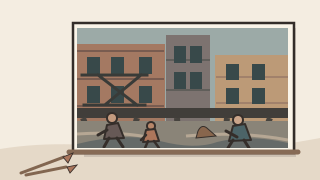
Painting Movement
Ashcan School
The Ashcan School was an American art movement known for lively, unsentimental depictions of everyday city life, especially in early twentieth-century New York.
Ashcan School quick facts
The movement grew around Robert Henri and fellow artists who valued direct observation, vigorous brushwork, and the variety of urban life.
| Origin | United States, especially Philadelphia and New York City |
|---|---|
| Approximate period | Early 1900s–1910s; associated painters continued working afterward |
| Alternative spelling | Ash Can School; the name was applied retrospectively, rather than chosen by a formally organized school |
| Leading figure | Robert Henri, who mentored several former Philadelphia newspaper illustrators |
| Defining characteristics | Everyday urban subjects, broad brushwork, dark or earthy palettes, and lively observation |
| Common subjects | City streets, tenements, theaters, crowds, boxing matches, and leisure activities |
| Associated painters | Robert Henri, John Sloan, George Luks, Everett Shinn, William Glackens, and George Bellows |
| The Eight | A group that exhibited together in New York in 1908; it included several Ashcan painters but was not identical to the Ashcan School |
| Name and recognition | The label gained currency in the 1910s and was later used in museum exhibitions |
| Artistic influences | European Realism and painters such as Frans Hals, Diego Velázquez, Honoré Daumier, and Édouard Manet |
| Paint medium | Oil paint, among other media; members also made drawings and prints |
| Painting surfaces | Canvas for many oil paintings and paper for works on paper |
Sources: The Met: The Ashcan School, The Met: The Ashcan School, The Eight, and the New York Art World, and Robert Henri Museum: The Ashcan School and The Eight.
Famous Ashcan School painters
Henri encouraged painting from life, Sloan observed everyday New Yorkers, and Bellows became known for energetic street and sporting scenes.
| Painter | Known for | Representative painting |
|---|---|---|
| Robert Henri | Portraits and vigorous observations of contemporary life | Snow in New York (1902) |
| John Sloan | Street scenes, city routines, and the everyday life of New Yorkers | McSorley's Bar (1912) |
| George Bellows | Crowded tenements, boxing, and energetic urban scenes | Cliff Dwellers (1913) |
| William Glackens | Urban recreation, parks, shops, and colorful city life | The Green Car (1910) |
| George Luks | Working-class figures, streets, and forceful portraits | Boy with Baseball (c. 1925) |
Sources: The Met: The Ashcan School, Whitney Museum: George Bellows, and Robert Henri Museum: The Ashcan School.
Related painting movements
The Ashcan School continued Realism's interest in ordinary life but focused on modern American cities rather than nineteenth-century France.
| Movement | How it differs |
|---|---|
| Realism | The French movement arose decades earlier and explored contemporary people and labor in a different social setting; both rejected idealization. |
| Impressionism | Placed greater emphasis on fleeting light and atmosphere, whereas Ashcan painters often used darker colors and direct urban storytelling. |
| Futurism | A later Italian avant-garde that fractured forms to depict speed and modern machines rather than observing city scenes in a largely representational style. |
Sources: The Met: The Ashcan School and MoMA: Futurism.