
John Sloan
John Sloan was an American Ashcan School painter known for candid New York street scenes, neighborhood routines, and direct observations of city life.

Painter
Robert Henri was an American painter and Ashcan School leader known for boldly brushed portraits, modern subjects, and influential teaching.
Henri helped establish the Ashcan circle, urged students to observe modern life, and organized The Eight’s 1908 exhibition, a landmark in his career.
| Full name | Robert Henry Cozad |
|---|---|
| Born | 1865 · Cincinnati, Ohio, United States |
| Died | 1929 · New York City, United States |
| Nationality | American |
| Movements | Ashcan School; American Realism |
| Paint types | Oil Paint · Watercolor Paint · Gouache Paint |
| Other media | — |
| Other materials | — |
| Painting surfaces | Canvas · Paper |
| Painting methods | Used direct, broad oil brushwork with strong light-dark contrasts and made rapid studies in watercolor and opaque gouache |
| Common subjects | Portraits, working people, children, dancers, city life, travel scenes, and individual sitters |
| Notable works | Snow in New York · Dutch Girl in White · Young Woman in White · Catharine |
Sources: National Gallery of Art: Robert Henri, National Gallery of Art: Selected works and media, The Met: Dutch Girl in White, oil on canvas, The Met: Central Park, watercolor on paper, The Met: F. Ambrose Clark, oil on canvas.
Henri’s Ashcan portraits use direct oil painting to capture individuals with lively brushwork and an informal, immediate quality on prepared canvas.

The Met records Henri’s Dutch Girl in White (1907) as oil on canvas. He used immediate brushwork and close observation to convey the sitter’s character, making the portrait feel direct rather than idealized. The painting documents oil on a traditional canvas support.

The National Gallery of Art catalogs Dancer in a Red Skirt, No. 2 as watercolor with ink and gouache on paper; the Met also records Central Park as watercolor on paper. These sheets show Henri using fluid color and drawing for both figure and urban subjects.

Gouache appears with watercolor and ink in Henri’s Dancer in a Red Skirt, No. 2, a mixed-media work on paper documented by the National Gallery of Art. The opaque paint adds denser passages beside fluid washes, while ink remains a separate drawing medium.
Sources: The Met: Dutch Girl in White, oil on canvas; The Met: Central Park, watercolor on paper; National Gallery of Art: selected Henri works, including Dancer in a Red Skirt, No. 2.
Documented works by Robert Henri use Canvas and Paper, with examples clarifying when a material is painted ground, backing, or part of a constructed work.

Henri’s portraits, including the Met’s Dutch Girl in White, are documented on canvas. He used the flexible support for direct, closely observed likenesses with energetic brushwork, distinct from the watercolor-and-ink works he made on paper. The collection entry identifies canvas as the work’s immediate support.

Henri’s drawings and studies use paper, as recorded in National Gallery collection records. Dancer in a Red Skirt, No. 2 combines watercolor, gouache, and ink on the sheet, documenting a portable works-on-paper practice alongside his oil portraits on canvas. The collection record names the sheet as the work’s documented support.
Sources: National Gallery of Art: Robert Henri, National Gallery of Art: Selected works and media, The Met: Dutch Girl in White, oil on canvas, The Met: Central Park, watercolor on paper, The Met: F. Ambrose Clark, oil on canvas.
Sloan was Henri's student and collaborator in The Eight, while Bellows studied with Henri and developed energetic scenes of city and sporting life.
John Sloan was an American Ashcan School painter known for candid New York street scenes, neighborhood routines, and direct observations of city life.
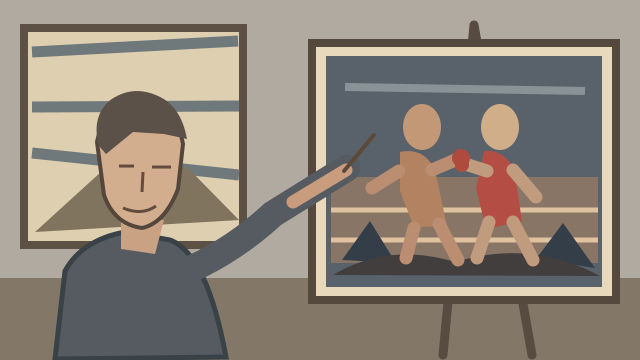
George Bellows was an American Ashcan School painter known for energetic scenes of New York City, boxing matches, crowded streets, and rough seas.