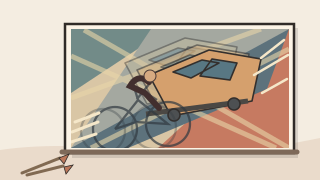
Painting Movement
Futurism
Futurism emerged in Italy in 1909, with painters breaking forms into repeated shapes and diagonal lines to convey speed, motion, and modern technology.
Futurism quick facts
Italian Futurist artists developed ways to show movement and simultaneous impressions, alongside manifestos that rejected artistic tradition.
| Origin | Italy, particularly Milan and Rome; the group later exhibited internationally |
|---|---|
| Approximate early period | 1909–1910s; later Futurist activity continued into the interwar period |
| Italian name | Futurismo |
| Founding manifesto | F. T. Marinetti published the first Futurist manifesto in 1909 |
| Painting manifestos | Futurist painters issued manifestos in 1910 defining a new approach to motion, color, and form |
| Defining characteristics | Repeated or fragmented forms, diagonal lines, rhythmic movement, and overlapping viewpoints |
| Common subjects | Trains, cars, crowds, factories, dancers, cyclists, streets, and other signs of modern life |
| Leading painters | Umberto Boccioni, Giacomo Balla, Gino Severini, Carlo Carrà, and Luigi Russolo |
| Major influences | Neo-Impressionist color division and Cubist fragmentation, used for different ends |
| Later development | Aeropittura (aerial painting), which depicted flight and views from above in the interwar period |
| Political context | Early manifestos glorified conflict, nationalism, and violent rejection of the past; these ideas are central to its history |
| Paint medium | Oil paint, among other media |
| Painting surfaces | Canvas, among other supports |
| Scope | A wider movement in literature, art, design, and performance, not exclusively painting |
Sources: MoMA: Futurism, Guggenheim: Futurist Painting, and Peggy Guggenheim Collection: Masterpieces of Futurism.
Famous Futurist painters
Boccioni explored the movement of people and cities, Balla studied changing positions over time, and Severini used dancers to express dynamism.
| Painter | Known for | Representative painting |
|---|---|---|
| Umberto Boccioni | Dynamic urban forms and the interaction of figures with their surroundings | The City Rises (1910) |
| Giacomo Balla | Repeated shapes, lines of speed, and studies of light | Dynamism of a Dog on a Leash (1912) |
| Gino Severini | Dancers, modern transport, and overlapping sensations of motion | Dancer = Propeller = Sea (1915) |
| Carlo Carrà | Crowds, social unrest, and fractured movement | The Funeral of the Anarchist Galli (1910–11) |
Sources: MoMA: Futurism, The Met: Severini's Dancer = Propeller = Sea, and Guggenheim: Giacomo Balla.
Related painting movements
Futurism borrowed some of Cubism's fragmentation but used it to emphasize speed and time rather than primarily rethinking how objects occupy space.
| Movement | How it differs |
|---|---|
| Cubism | Fragmented forms to explore multiple viewpoints and picture space, whereas Futurism emphasized dynamism, motion, and modern technology. |
| Neo-Impressionism | Used divided color to investigate optical effects; early Futurist painters adopted aspects of Divisionism for their own experiments. |
| Orphism | A related French abstract movement that developed rhythmic form and color without Futurism's central emphasis on speed and machines. |
Sources: Guggenheim: Boccioni's Materia and MoMA: Futurism.