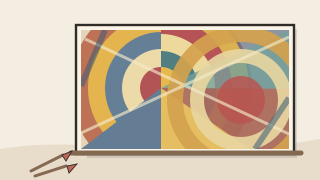
Painting Movement
Orphism
Orphism emerged around 1912 in Paris as painters developed colorful, rhythmic abstraction from Cubism, exploring how light and color interact.
Orphism quick facts
Robert and Sonia Delaunay and František Kupka explored color as a subject in itself, moving beyond the recognizable objects of early Cubism.
| Origin | Paris, France |
|---|---|
| Approximate period | Around 1912–mid-1910s; associated painters developed their approaches beyond that period |
| Related name | Orphic Cubism; French: orphisme |
| Term coined by | Poet and critic Guillaume Apollinaire around 1912–1913, drawing an analogy between abstract painting and music |
| Leading painters | Robert Delaunay, Sonia Delaunay, and František Kupka |
| Defining characteristics | Strong color contrasts, overlapping circular or prismatic forms, and rhythmic arrangements |
| Color theory | Simultaneous contrast, including how adjacent colors change one another's visual effect |
| Relationship to Cubism | Influenced by Cubism, but with more emphasis on vivid color, light, and nonrepresentational composition |
| Simultanism | Robert Delaunay's term for his experiments with simultaneous color; related to Orphism, not a separate formal movement |
| Typical subjects | Abstract color, light, circles, windows, and modern urban sensations |
| Paint medium | Oil paint, among other media |
| Painting surfaces | Canvas, among other supports |
| Scope | A critically recognized tendency in early abstract painting, not a uniformly organized artists' group |
Sources: MoMA: Orphism, MoMA: Simultaneous Contrasts: Sun and Moon, and Larousse: Orphisme.
Famous Orphist painters
Robert and Sonia Delaunay developed bold color contrasts, while Kupka pursued independent experiments in abstraction and visual rhythm.
| Painter | Known for | Representative painting |
|---|---|---|
| Robert Delaunay | Simultaneous color contrasts and luminous, overlapping abstract shapes | Simultaneous Contrasts: Sun and Moon (1913; dated 1912 on the painting) |
| Sonia Delaunay | Vibrant color relationships in painting, textiles, and design | Portuguese Market (1915) |
| František Kupka | Independent abstract research into color, form, and visual rhythm | Mme Kupka among Verticals (1910–1911) |
Sources: MoMA: Robert Delaunay, MoMA: Sonia Delaunay, and MoMA: František Kupka.
Related painting movements
Orphism drew on Cubist fragmentation and earlier color experiments but made luminous contrasts and abstract visual rhythm central to painting.
| Movement | How it differs |
|---|---|
| Cubism | Often analyzed objects through fragmented forms and multiple viewpoints, while Orphism foregrounded light and interactions of pure color. |
| Neo-Impressionism | Studied separated color through deliberate strokes or dots, rather than Orphism's larger prismatic or geometric abstractions. |
| Futurism | Frequently used fragmentation to convey speed, machines, and motion; Orphism more directly explored color and light as independent subjects. |
Sources: MoMA: Orphism and MoMA: Robert Delaunay's color experiments.