Painting Movement
Neo-Impressionism
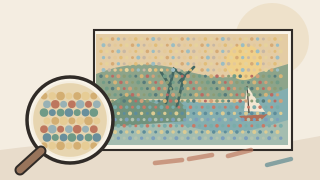
Neo-Impressionism emerged in France in the 1880s as painters separated colors into measured strokes or dots, guided by theories of light and color.
Neo-Impressionism quick facts
Seurat and Signac developed a deliberate way of placing colors side by side, replacing much Impressionist spontaneity with planned compositions.
| Origin | France, especially Paris |
|---|---|
| Approximate early period | 1886–1906; Neo-Impressionist painting continued afterward |
| French name | Néo-impressionnisme |
| Leading painters | Georges Seurat and Paul Signac |
| Early milestone | Seurat's A Sunday on La Grande Jatte—1884 exhibited in 1886 |
| Name | Critic Félix Fénéon used the term Neo-Impressionism in 1886 |
| Defining characteristics | Separated touches of color, deliberate composition, and interest in optical effects |
| Divisionism | A method of placing separate colors alongside one another, based on contemporary color theory |
| Pointillism | A technique of painting with small dots; not a separate movement or an exact synonym for Neo-Impressionism |
| Color theory | Juxtaposed hues were intended to interact visually when seen from a distance |
| Common subjects | Riverbanks, landscapes, coastal views, urban leisure, and everyday life |
| Painting media | Oil paint, among other media |
| Painting surfaces | Canvas and paper, depending on the work |
Sources: National Galleries of Scotland: Neo-Impressionism, The Met: Neo-Impressionism, and National Galleries of Scotland: Pointillism.
Famous Neo-Impressionist painters
Seurat helped establish the movement, Signac developed its theories and practice, and Cross later used larger strokes and more saturated color.
| Painter | Known for | Representative painting |
|---|---|---|
| Georges Seurat | Systematic color separation and carefully constructed compositions | A Sunday on La Grande Jatte—1884 |
| Paul Signac | Developing Neo-Impressionist color theory and later mosaic-like brushwork | Hillside from Downstream, Les Andelys |
| Henri-Edmond Cross | Brighter colors and larger, separated strokes in Mediterranean landscapes | The Beach at Saint-Clair |
Sources: Art Institute of Chicago: Seurat, Art Institute of Chicago: Signac, and The Met: Cross and Signac.
Related painting movements
Impressionism emphasized immediate observation, while Neo-Impressionism was more systematic; Fauvist painters later experimented with divided color.
| Movement | How it differs |
|---|---|
| Impressionism | Shared subjects of light and modern life, but usually used freer, less systematically planned brushwork. |
| Post-Impressionism | A wider retrospective label covering several different artistic directions, including but not limited to Neo-Impressionism. |
| Fauvism | A later French movement using exaggerated color more freely; some Fauvist painters first experimented with divisionist techniques. |
Sources: National Galleries of Scotland: Neo-Impressionism and The Met: Neo-Impressionism.