
Oil Paint
Oil paint is a slow-drying art medium made with pigment and a drying-oil binder that allows extended working time, smooth blending, and layered application.
Painter
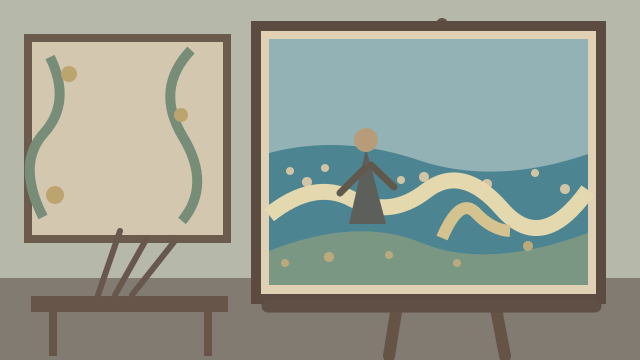
Jan Toorop was a Dutch-Indonesian painter and designer whose changing practice spanned naturalistic coastal paintings, Pointillism, Symbolism, and flowing Art Nouveau graphics.
Toorop painted in markedly different styles. His pointillist oil canvases and Symbolist imagery are not the same media as his colored-chalk drawings or lithographed advertising posters.
| Born | December 20, 1858 · Poerworedjo, Java, Dutch East Indies (now Purworejo, Indonesia) |
|---|---|
| Died | March 3, 1928 · The Hague, Netherlands |
| Nationality | Dutch |
| Movements | Art Nouveau · Symbolism · Neo-Impressionism (Pointillism) |
| Paint types | Oil paint on canvas and cardboard · watercolor on paper (also combined with chalk in drawings) |
| Painting surfaces | Canvas · cardboard · paper for watercolors and drawings |
| Painting methods | Applied oil with brushes and palette knives; separately experimented with divided-color dots, expressive lines, and watercolor and chalk on paper |
| Common subjects | Fishing communities, breaking waves, portraits, allegorical women, spirituality, and symbolic figures |
| Notable works | The Sea (1887) · High Tide (1891) · Hetäre (1890) · Delft Salad Oil poster (1894, a print) |
Sources: Rijksmuseum: The Sea, National Gallery: High Tide, Rijksmuseum: watercolor-and-chalk self-portrait, Rijksmuseum: Women by the Sea, oil on cardboard, Centraal Museum: life dates.
The Rijksmuseum describes The Sea (1887) as oil on canvas applied partly with a brush and partly with a palette knife, and it catalogs his 1881 self-portrait as watercolor and chalk on paper. The National Gallery identifies High Tide as oil on canvas. Chalk and poster lithography are separate media, not paint types.
Oil paint is a slow-drying art medium made with pigment and a drying-oil binder that allows extended working time, smooth blending, and layered application.

Watercolor paint is a water-based art medium made with pigment and a water-soluble binder, typically applied in transparent washes on absorbent paper.
Toorop used canvas for documented coastal oils, cardboard for another oil painting cataloged by the Rijksmuseum, and paper for watercolor-and-chalk drawings. Support and medium should be considered together rather than generalized across his entire career.

Canvas is a woven fabric support, commonly cotton or linen, used for painting and sold either raw or prepared with a compatible ground layer.

Cardboard is a lightweight, absorbent paper-based sheet material whose fibers and corrugated layers can soften or warp when exposed to heavy wet coats.

Paper is an absorbent sheet material made from pressed fibers, with weight, sizing, and surface texture controlling moisture tolerance and paint behavior.
Toorop's ornamental Symbolist imagery influenced Klimt, while his phase of separated-color oil painting connects with Seurat's Neo-Impressionism.
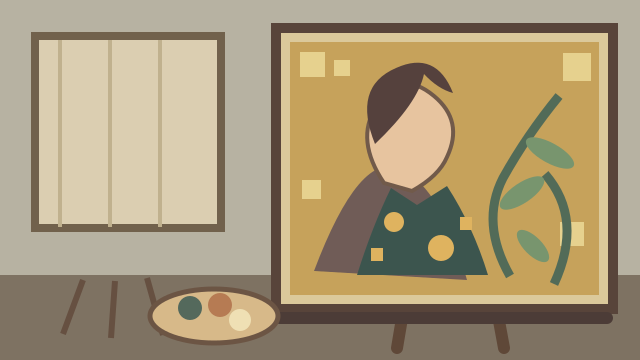
Gustav Klimt was an Austrian painter and a founder of the Vienna Secession, known for patterned portraits, landscapes, allegories, and gold-leaf details in his paintings.
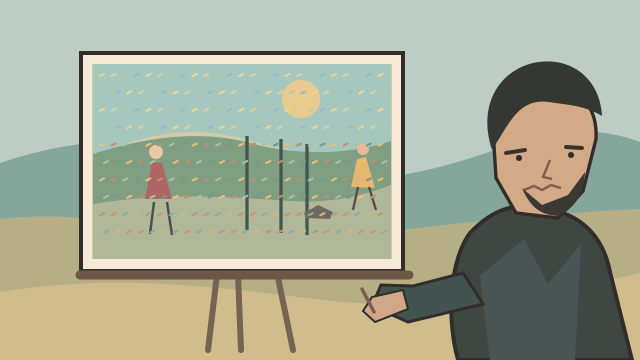
Georges Seurat was a French Neo-Impressionist painter known for carefully planned compositions, separate dots of color, and detailed oil studies of modern life.