Painting Movement
Symbolism
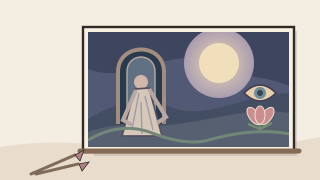
Symbolism developed across Europe in the late nineteenth century as painters used dreams, myths, and mysterious imagery to suggest emotions and ideas.
Symbolism quick facts
Symbolist artists valued suggestion over literal description, using figures, colors, and imaginary settings to explore inner experiences.
| Origins | France and Belgium, with related artists and traditions across Europe |
|---|---|
| Approximate period | 1880s–1910s; important painting precedents date from the 1860s and 1870s |
| French name | Symbolisme |
| Literary context | Developed alongside late-nineteenth-century Symbolist poetry and criticism |
| Literary milestone | Jean Moréas's Symbolist manifesto published in 1886 |
| Defining characteristics | Suggestive imagery, personal symbolism, imagined worlds, and subjects drawn from dreams or myth |
| Common subjects | Spirituality, mythology, mysterious figures, desire, mortality, and emotional or psychological states |
| Notable painters | Gustave Moreau, Odilon Redon, Fernand Khnopff, and Pierre Puvis de Chavannes |
| Representative paintings | Moreau's Oedipus and the Sphinx (1864) and Redon's Pandora (c. 1914) |
| Painting media | Oil paint, among other media; Symbolist artists also worked in printmaking and drawing |
| Painting surfaces | Canvas and paper, depending on medium and artist |
| Scope | A broad artistic and literary movement, not a single painting technique or unified school |
Sources: The Met: Symbolism and The Met: Oedipus and the Sphinx.
Famous Symbolist painters
Moreau drew on ancient mythology, Redon explored imagined worlds and dreams, and Khnopff developed enigmatic portraits and private symbols.
| Painter | Country | Known for |
|---|---|---|
| Gustave Moreau | France | Mythological and biblical subjects, elaborate detail, and imagined scenes |
| Odilon Redon | France | Dreamlike creatures, visionary imagery, and later richly colored paintings |
| Fernand Khnopff | Belgium | Enigmatic figures, introspective portraits, and recurring private symbols |
| Pierre Puvis de Chavannes | France | Quiet, allegorical compositions with simplified figures and muted color |
Source: The Met: Symbolism.
Related painting movements
Symbolism turned from direct observation toward subjective meanings; the Nabis pursued some of these ideas through flat color and decoration.
| Movement | How it differs |
|---|---|
| Realism | Focused on recognizable people and everyday life, rather than suggesting spiritual or psychological ideas through invented imagery. |
| Impressionism | Often studied changing light and visible appearances, whereas Symbolism emphasized inner feeling and ideas. |
| Nabis | A specific circle of painters who shared some Symbolist ideas but placed particular emphasis on decorative surfaces and flat color. |
| Surrealism | A later movement shaped by the unconscious and automatism; dream imagery alone does not make Symbolist painting Surrealist. |
Sources: The Met: Symbolism and The Met: The Nabis and Decorative Painting.