
Oil Paint
Oil paint is a slow-drying paint made with pigment and a drying oil binder. It is widely used for artwork because it blends smoothly and develops rich color.

Painting Movement
Art Nouveau brought flowing botanical lines and decorative unity to fin-de-siècle art, especially design, illustration, and some painting.
Art Nouveau was an international art and design movement marked by flowing lines, botanical ornaments, and decorative unity; painting was one of several art forms it influenced.
| Origin | France and Belgium, with regional styles across Europe and beyond |
|---|---|
| Approximate period | 1890s–1910s |
| Name | Art Nouveau is French for New Art. Jugendstil and Stile Liberty name related regional styles rather than separate painting-only schools. |
| Appearance | Curved organic forms, stylized figures, floral motifs, and integrated surface decoration |
| Painting context | Painting overlapped Symbolism, the Nabis, and the Vienna Secession, while posters, architecture, and decorative art were more prominent |
| Media | Oil paintings, watercolor and gouache designs, and printmaking; prints must not be confused with paintings |
| Artists | Alphonse Mucha, Gustav Klimt, Koloman Moser, and Jan Toorop represented different artistic and regional approaches |
| Surfaces | Canvas, paper, and decorated panels; some styles extended to architectural interiors |
Sources: MoMA: Art Nouveau, The Met: Art Nouveau.
Oil, gouache, and watercolor suit flowing outlines and intricate pattern, while modern acrylic and metallic paints offer alternatives for recreating decorative effects.
Oil paint is a slow-drying paint made with pigment and a drying oil binder. It is widely used for artwork because it blends smoothly and develops rich color.

Gouache paint is an opaque, water-based art medium made with pigment and a water-soluble binder. Traditional formulas dry to a matte finish and can be reactivated with water.

Watercolor paint is a water-based art medium made with pigment and a water-soluble binder. It is known for transparent color that settles into absorbent paper.

Acrylic paint is a fast-drying, water-based paint made with pigment and an acrylic polymer binder. It is widely used in art and decorative projects because it is versatile and durable.

Acrylic gouache is an opaque acrylic paint that dries to a flat matte finish while forming a permanent, water-resistant film unlike traditional gouache.

Metallic paint contains reflective particles that create a metal-like shimmer or sheen, with preparation and durability depending on the exact coating formula.
Art Nouveau encompassed painting, illustration, and design; its best-known figures should not all be classified solely as easel painters.
| Artist | Contribution |
|---|---|
| Alphonse Mucha | Decorative posters and designs with curving plants and figures; he also made oil paintings |
| Gustav Klimt | Vienna Secession painter whose patterned portraits reflect related Art Nouveau ideas |
| Koloman Moser | Artist and designer who worked across painting and the decorative arts |
| Jan Toorop | Dutch painter whose Symbolist and linear Art Nouveau works crossed stylistic boundaries |
Art Nouveau shared the Nabis' decorative surfaces and Symbolism's evocative imagery, but its scope was broader than painting.

Symbolism developed across Europe in the late nineteenth century as painters used dreams, myths, and mysterious imagery to suggest emotions and ideas.
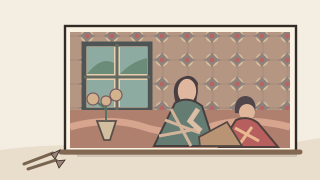
The Nabis were a French group of painters active from 1888 to about 1900 who used flat color, simplified shapes, and decorative patterns in their art.
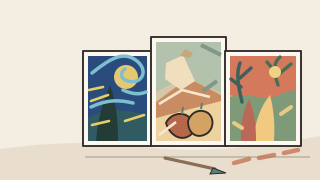
Post-Impressionism describes several distinct approaches to painting after Impressionism, from expressive color to symbolism and structured form.