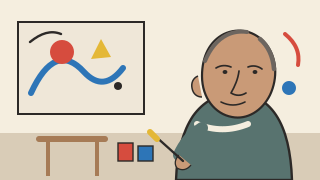
Joan Miró
Joan Miró was a Spanish artist associated with Surrealism, known for biomorphic forms, symbolic imagery, vivid color, and abstract compositions across painting and printmaking.

Painting Movement
Surrealism grew from a Paris-based movement exploring dreams and the unconscious through unexpected imagery, automatic drawing, and imaginative painting.
Surrealism began with André Breton's 1924 manifesto and developed distinct artistic approaches, from spontaneous marks to precisely painted dream scenes.
| Origin | Paris, France, emerging from literary and artistic circles |
|---|---|
| Approximate period | 1924–1940s as an organized movement; its influence continued afterward |
| Founding manifesto | André Breton's Manifesto of Surrealism (1924) |
| French name | Surréalisme |
| Defining characteristics | Dream imagery, startling juxtapositions, unconscious associations, and irrational scenes |
| Major painters | Salvador Dalí, René Magritte, Max Ernst, and Joan Miró |
| Painting approaches | Illusionistically rendered impossible scenes and more spontaneous, biomorphic abstraction |
| Experimental methods | Automatism, collage, frottage (rubbings), and chance-based techniques |
| Common subjects | Dream landscapes, altered everyday objects, bodies, symbols, and unexpected encounters |
| Paint types | Oil paint and gouache, among other media |
| Representative works | Dalí's The Persistence of Memory, Magritte's The Menaced Assassin, and Miró's The Birth of the World |
Sources: MoMA: Surrealism, MoMA: Surrealism and dreams, and The Met: Surrealism.
Dalí and Magritte created uncanny, carefully rendered scenes, while Miró developed a more abstract language of symbols and spontaneous forms.
Joan Miró was a Spanish artist associated with Surrealism, known for biomorphic forms, symbolic imagery, vivid color, and abstract compositions across painting and printmaking.
Other major Surrealist painters include Salvador Dalí, René Magritte, and Max Ernst.
Symbolism anticipated Surrealism's dream imagery, while Giorgio de Chirico's earlier Metaphysical Painting provided a direct visual precedent.
| Movement | How it differs |
|---|---|
| Symbolism | An earlier movement concerned with myths, dreams, and spiritual ideas; it did not share Surrealism's organized program of automatism and the unconscious. |
| Metaphysical Painting | De Chirico's earlier Italian approach used deserted plazas and mysterious object pairings, influencing Surrealists without being part of their movement. |
Sources: MoMA: Giorgio de Chirico, MoMA: Surrealist strategies, and The Met: Surrealism.