Salvador Dalí
Salvador Dalí was a Spanish Surrealist painter known for meticulously rendered dream scenes, uncanny objects, and precise oil-painting techniques.
Painter
René Magritte was a Belgian Surrealist painter known for placing familiar objects in puzzling scenes that challenge how images represent reality.
Magritte tested Cubist and Futurist styles before developing the precise, unsettling images associated with his Surrealist paintings and visual puzzles.
| Full name | René François Ghislain Magritte |
|---|---|
| Born | November 21, 1898 · Lessines, Belgium |
| Died | August 15, 1967 · Brussels, Belgium |
| Nationality | Belgian |
| Movements | Surrealism |
| Paint types | Oil paint · Gouache |
| Other media | Drawing, collage, and graphic design |
| Other materials | — |
| Painting surfaces | Canvas · Paper |
| Painting methods | Used carefully modeled oil paint and developed related composition studies and variations in gouache on paper |
| Common subjects | Clouds, pipes, bowler hats, apples, windows, mirrors, and ordinary objects in unexpected relationships |
| Notable works | The Treachery of Images, The Lovers, The False Mirror, and The Empire of Light |
Sources: MoMA: René Magritte, MoMA: The Empire of Light, II, MoMA: The False Mirror, National Galleries of Scotland: gouache on paper, Museum Boijmans Van Beuningen: Le poison.
Magritte painted precise Surrealist scenes in oil on canvas and developed visual puzzles in opaque gouache on paper and board, including related works.

The False Mirror (1929) is oil on canvas: the cloud-filled sky replaces the iris of a carefully modeled eye. In The Empire of Light, II (1950), also oil on canvas, Magritte placed a sunlit sky above a dark street lit by lamps. Both paintings use familiar, convincingly rendered objects to create an impossible or puzzling combination.
Magritte's Le poison (1939) is gouache on paper, an early day-and-night scene later developed in his Empire of Light paintings. An Untitled gouache (c. 1935–36) at the National Galleries of Scotland brings together clouds, bells, and an interior setting; it was made for a Surrealist fundraising portfolio. These paper works are not oil paintings.
Sources: MoMA: The False Mirror, oil on canvas, MoMA: The Empire of Light, II, oil on canvas, Museum Boijmans Van Beuningen: Le poison, gouache on paper, and National Galleries of Scotland: Untitled, gouache on paper.
Documented works by René Magritte use Canvas and Paper, with examples clarifying when a material is painted ground, backing, or part of a constructed work.
Magritte’s oil paintings, including The False Mirror (1929) and The Empire of Light, II (1950), are documented on canvas. He rendered familiar objects convincingly, then combined them in impossible scenes such as a cloud-filled sky replacing an iris or daylight above a dark street.

Magritte’s drawings and selected painted works use paper. The Menil Collection records his gouache Le poison (1939) on paper, an early day-and-night scene that anticipates the Empire of Light paintings. These sheets document a works-on-paper practice distinct from oil on canvas.
Sources: MoMA: René Magritte, MoMA: The Empire of Light, II, MoMA: The False Mirror, National Galleries of Scotland: gouache on paper, Museum Boijmans Van Beuningen: Le poison.
Surrealists used dreamlike imagery in varied ways, offering comparisons with Magritte's precise scenes and unsettling shifts in ordinary objects.
Salvador Dalí was a Spanish Surrealist painter known for meticulously rendered dream scenes, uncanny objects, and precise oil-painting techniques.
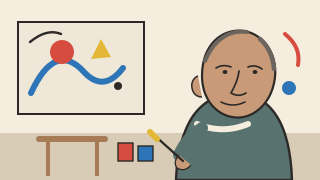
Joan Miró was a Spanish artist associated with Surrealism, known for biomorphic forms, symbolic imagery, vivid color, and abstract painting and prints.