Painting Movement
Metaphysical Painting
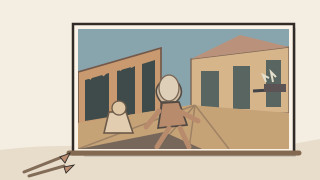
Metaphysical Painting developed in Italy in the 1910s, presenting silent plazas, unlikely objects, and distorted spaces that make familiar scenes feel strange.
Metaphysical Painting quick facts
De Chirico's enigmatic pictures of arcades, mannequins, and long shadows established a visual language that later influenced Surrealism.
| Origin | Italy; de Chirico also developed his early style while working in Paris |
|---|---|
| Approximate period | About 1911–1919, with key collaborative activity in Ferrara during 1917–1918 |
| Italian name | Pittura metafisica; the related group was called Scuola Metafisica |
| Pioneering painter | Giorgio de Chirico, whose early metaphysical works preceded the organized group |
| Other associated painters | Carlo Carrà and Giorgio Morandi, whose engagement was particularly important in the late 1910s |
| Defining characteristics | Unexpected object arrangements, classical architecture, strange perspective, deep shadows, and unsettling stillness |
| Recurring motifs | Empty piazzas, statues, arcades, mannequins, towers, trains, and ordinary objects placed in unfamiliar settings |
| Historical development | De Chirico's work in the early 1910s developed into a wider movement involving Carrà and Morandi |
| Artistic influences | Classical art, German Romantic thought, and the philosophical writings of Nietzsche and Schopenhauer |
| Later influence | Especially important for the imagery and unexpected juxtapositions of Surrealism |
| Paint medium | Oil paint was used for major works |
| Painting surfaces | Canvas, among other supports |
| Scope | A historical painting tendency rather than a general label for all mysterious-looking art |
Sources: Musée de l'Orangerie: Metaphysical Painting, MoMA: Giorgio de Chirico, and MoMA: Metaphysical Painting.
Famous Metaphysical painters
De Chirico pioneered the movement's eerie imagery, Carrà explored tightly staged still lifes, and Morandi briefly used its enigmatic forms.
| Painter | Known for | Representative painting |
|---|---|---|
| Giorgio de Chirico | Deserted plazas, classical buildings, unsettling perspectives, and enigmatic objects | The Nostalgia of the Infinite (c. 1912–1913) |
| Carlo Carrà | Metaphysical still lifes and geometric arrangements following his Futurist period | Still Life with Triangle (1917) |
| Giorgio Morandi | Restrained geometric still lifes during a short Metaphysical phase | Great Metaphysical Still Life (1918) |
Sources: MoMA: The Nostalgia of the Infinite, MoMA: Still Life with Triangle, and Palazzo Citterio: Great Metaphysical Still Life.
Related painting movements
Metaphysical Painting preceded Surrealism and shared its interest in strange juxtapositions, but arose from a different artistic context.
| Movement | How it differs |
|---|---|
| Surrealism | A later movement that used dreams and the unconscious, partly inspired by de Chirico's earlier disquieting images. |
| Futurism | Emphasized speed, modern technology, and motion; Metaphysical Painting often made time and action seem suspended. |
| Cubism | Fragmented forms and multiple viewpoints, while Metaphysical painters constructed apparently recognizable but spatially improbable scenes. |
Sources: MoMA: Giorgio de Chirico and Musée de l'Orangerie: Metaphysical Painting.