
Vincent van Gogh
Vincent van Gogh was a Dutch Post-Impressionist painter known for expressive color, energetic brushwork, and a highly visible paint surface.

Painting Surface
Painting board is a rigid artist support made from hardboard, wood, or another stable panel, sold either raw or prepared with a medium-specific ground.
Painting board can support acrylic, oil, tempera, casein, encaustic, and other media when its rigidity, absorbency, heat resistance, and ground suit the paint.
| Paint | Compatibility | Preparation | Primer or ground | Finish | Guide |
|---|---|---|---|---|---|
| Acrylic paint | Excellent on an acrylic-ready panel | Use a clean, stable pre-primed board or prepare a raw panel before painting. | Acrylic gesso or another acrylic-compatible ground. | Optional varnish after the painting is fully dry. | — |
| Acrylic gouache | Excellent on an acrylic-ready rigid support | Use a clean, dry, stable board intended for painting. | Apply an acrylic ground when the board is raw, absorbent, or not already prepared for acrylic media. | Flat matte acrylic finish; protect from abrasion or handling when needed. | — |
| Iridescent paint | Excellent on an acrylic-ready rigid panel | Use a clean, dry, stable board intended for acrylic painting. | Apply an acrylic-compatible ground when the panel is raw or not already prepared. | Test over light and dark base colors because the iridescent or interference effect can change substantially. | — |
| Oil paint | Excellent with a suitable ground | Confirm that the board is rigid, clean, dry, and intended for oil painting. | Use an existing oil-ready ground or apply a suitable oil painting primer. | Optional final varnish after the painting has dried sufficiently. | — |
| Water-mixable oil paint | Excellent with oil-compatible preparation | Use a stable board prepared for traditional or water-mixable oil paint. | Artist acrylic gesso or an oil ground approved for the paint. | Optional varnish after the painting has dried as directed. | — |
| Egg tempera | Excellent when the board is rigid and prepared for egg tempera | Use a clean, stable, rigid board and make the surface as smooth and even as the chosen technique requires. | Traditional gesso or a purpose-made tempera ground. | Build the painting in thin layers and allow it to mature fully before any optional protective treatment. | — |
| Casein paint | Excellent when the board is rigid and porous | Use a clean, dry, dimensionally stable board and smooth the surface as needed. | Use a casein-compatible ground or casein gesso when a prepared painting surface is wanted. | Allow the paint to cure fully before optional polishing or another compatible protective treatment. | — |
| Encaustic paint | Excellent when the board is rigid, absorbent, and heat resistant | Use a stable board that can tolerate repeated warming and the weight of wax layers. | Use encaustic gesso or another absorbent ground specifically approved for encaustic painting. | Fuse layers with controlled heat as required by the technique. | — |
Sources: Gamblin sizes and grounds, Ampersand Gessobord, Ampersand panel priming guidance, Liquitex Professional Acrylic Gouache, Natural Pigments tempera grounds, Natural Pigments casein guidance, R&F encaustic grounds and surfaces, and Golden High Flow Acrylic Colors.
Browse PaintZeal painter profiles featuring artists who worked on painting board, with examples of rigid supports, prepared grounds, and traditional studio media.
Vincent van Gogh was a Dutch Post-Impressionist painter known for expressive color, energetic brushwork, and a highly visible paint surface.

Frida Kahlo was a Mexican painter known for psychologically intense self-portraits and paintings exploring identity, family, physical pain, relationships, and Mexican culture.
Andrew Wyeth was an American painter known for closely observed landscapes, interiors, and people from Chadds Ford, Pennsylvania, and coastal Maine.

Paul Klee was a Swiss-born German artist and Bauhaus teacher whose highly experimental work combined color, geometry, symbols, humor, music, and observations of nature.

Jacob Lawrence was an American painter known for vivid narrative series about Black life and history, especially The Migration Series, created with quick-drying tempera on hardboard panels.

George Tooker was an American painter known for meticulously layered egg tempera scenes that turn offices, subways, waiting rooms, and other modern spaces into quiet studies of isolation and social tension.

Paul Cadmus was an American painter known for highly controlled figurative paintings, social satire, and a long commitment to egg tempera.

Reginald Marsh was an American painter and illustrator known for energetic scenes of New York City crowds, Coney Island, burlesque theaters, and street life.
Robert Vickrey was an American painter and illustrator known for meticulously detailed egg tempera paintings that combine realistic observation with unsettling symbolic imagery.

Ben Shahn was an American painter and graphic artist known for socially engaged imagery, expressive line, and paintings made with tempera.

Koo Schadler is an American painter known for contemporary egg tempera paintings, metalpoint drawings, and teaching traditional painting methods.

James Gurney is an American painter, illustrator, and author known for imaginative realism, outdoor sketching, and extensive work in casein, gouache, watercolor, and oil.

Alicia McCarthy is an American painter associated with San Francisco's Mission School whose work often uses modest materials including house paint, spray paint, gouache, colored pencil, and wood.

Bernard Perlin was an American painter and illustrator whose figurative work included casein paintings on rigid supports as well as wartime and editorial art.

Billy Al Bengston was an American painter associated with postwar Los Angeles who adapted automotive lacquer, enamel, aluminum, and high-gloss finishing methods to fine-art painting.

Bridget Riley is a British painter known for tightly controlled abstract compositions that create optical movement through repeated lines, curves, shapes, and carefully calibrated color relationships.

David Alfaro Siqueiros was a Mexican painter and muralist who deliberately embraced modern industrial materials and methods, including lacquer, enamel, pyroxylin, and automotive coatings, as alternatives to traditional easel-painting materials.

Édouard Vuillard was a French painter known for intimate interiors, gardens, patterned surfaces, and decorative compositions in distemper, oil, and other media.

Gary Simmons is an American artist known for drawing on chalkboard-like painted grounds and then smearing or erasing the image so memory, absence, and physical gesture become part of the work.
Josephine Halvorson is an American painter known for making closely observed paintings on location. She uses fast-drying acrylic gouache on absorbent grounds so each brushstroke records a direct, largely irreversible response to what she sees.

Lucia Di Luciano is an Italian artist associated with Arte Programmata and mathematically structured geometric abstraction. Tate documents her 1964 painting Discontinuous Structural Articulation as black and white household emulsion paint on Masonite.
Mark Tobey was an American painter known for atmospheric abstractions built from dense networks of gestural marks and for working in casein, tempera, and other media.
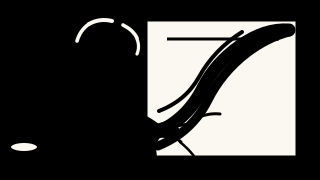
Mohamed Melehi was a Moroccan painter known for crisp hard-edge abstraction and rhythmic wave forms, including glossy works made with industrial lacquer applied by spray gun.

Sidney Nolan was an Australian painter whose early work made extensive use of fluid, fast-drying commercial enamel paint, especially Ripolin, to build stark figures and landscapes with unusually direct color.
No related PaintZeal articles are currently available.