
Jasper Johns
Jasper Johns is an American artist known for turning familiar symbols such as flags, targets, numbers, and maps into tactile paintings and objects that question how images are seen and understood.

Paint Type
Encaustic paint is a wax-based art medium in which pigment is suspended in melted wax, applied warm, and fused with heat to form a durable painted surface.
Encaustic paint works best on rigid, absorbent, heat-resistant surfaces, while flexible supports can move enough to stress or crack the fused wax layers.
| Surface | Compatibility | Preparation | Primer or ground | Finish | Guide |
|---|---|---|---|---|---|
| Painting Board | Excellent when rigid, absorbent, and heat resistant | Use a stable board that can tolerate repeated warming and the weight of wax layers. | Use encaustic gesso or another absorbent ground specifically approved for encaustic painting. | Fuse layers with controlled heat as required by the technique; the wax surface can be left natural or polished when appropriate. | — |
| Wood Panel | Excellent on stable rigid wood | Use clean, dry, dimensionally stable wood and remove dust or surface contamination. | Raw wood can sometimes be used directly, or apply an encaustic-compatible absorbent ground. | Build and fuse the wax layers without overheating the support or paint. | — |
| Plaster | Good when rigid, fully dry, absorbent, and heat resistant | Make sure the plaster is fully cured, sound, clean, and dry before applying wax paint. | Use an encaustic-compatible ground only when the surface needs additional preparation. | Fuse carefully because both the support and surrounding construction must tolerate the working heat. | — |
| Unglazed Ceramic | Good when rigid, porous, and heat resistant | Use clean, dry, unglazed ceramic and confirm the object can safely tolerate encaustic working temperatures. | Usually none on a suitably absorbent unglazed surface; test adhesion first. | Fuse with controlled heat and avoid thermal shock to the ceramic. | — |
Sources: R&F encaustic grounds and surfaces, R&F encaustic supplies, and Ampersand Encausticbord.
Browse PaintZeal painter profiles featuring artists who used encaustic paint, with examples of fused wax layers, heated tools, and mixed-media techniques.
Jasper Johns is an American artist known for turning familiar symbols such as flags, targets, numbers, and maps into tactile paintings and objects that question how images are seen and understood.
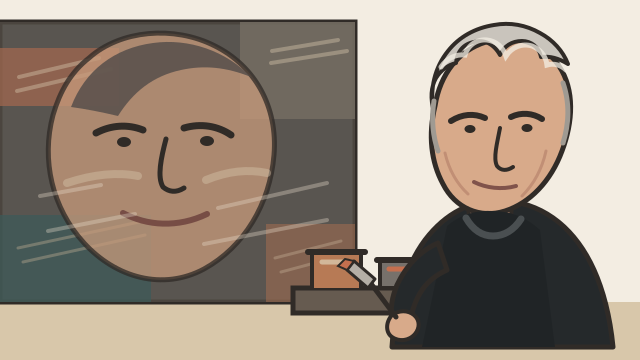
Tony Scherman is a Canadian painter known for figurative and historical paintings made with encaustic, an uncommon wax-and-pigment medium he has used for decades.
Betsy Eby is an American painter and musician known for abstract encaustic paintings that connect layered wax, gestural line, color, rhythm, and musical structure.

Martin Kline is an American painter known for abstract works built from encaustic and pigmented wax on rigid wood panels, often creating pronounced layered relief.
No related PaintZeal articles are currently available.