
Encaustic Paint
Encaustic paint suspends pigment in a wax-based medium that is melted for application and fused with heat. Beeswax is the main component of many traditional encaustic systems.

Painter
Jasper Johns is an American artist known for paintings and objects based on familiar symbols such as flags, targets, numbers, and maps, often using encaustic and collage.
Johns’s Neo-Dada work drew on Marcel Duchamp’s ideas from Dada, using familiar signs and everyday objects to question what painting represents.
| Born | May 15, 1930 · Augusta, Georgia, U.S. |
|---|---|
| Died | — |
| Nationality | American |
| Movements | Neo-Dada and Pop Art |
| Paint types | Encaustic paint · Oil paint · Metallic paint · Acrylic paint · Watercolor · Gouache |
| Painting surfaces | Canvas · Paper · Wood · Fabric · Plywood · Plaster · Metal |
| Painting methods | Hot-wax encaustic layering over collaged newspaper and fabric |
| Other media | Collage, drawing, printmaking, sculpture, plaster, and found materials |
| Common subjects | American flags, targets, numbers, letters, maps, body impressions, and everyday objects |
| Notable works | Flag, Target with Four Faces, Three Flags, and Map |
Sources: Whitney Museum of American Art, MoMA: Flag, MoMA: Target with Four Faces, MoMA: Untitled (2001 series), National Gallery of Art: Numbers, MoMA: Painted Bronze, and National Gallery of Art.
See the paint types documented in Johns's work, with links to PaintZeal references explaining each medium's properties, uses, and working characteristics.
Encaustic paint suspends pigment in a wax-based medium that is melted for application and fused with heat. Beeswax is the main component of many traditional encaustic systems.

Oil paint is a slow-drying paint made with pigment and a drying oil binder. It is widely used for artwork because it blends smoothly and develops rich color.

Metallic paint contains fine reflective particles that create a metal-like shimmer. The effect depends on particle orientation, film thickness, and lighting.

Acrylic paint is a fast-drying, water-based paint made with pigment and an acrylic polymer binder. It is widely used in art and decorative projects because it is versatile and durable.

Watercolor paint is a water-based art medium made with pigment and a water-soluble binder. It is known for transparent color that settles into absorbent paper.

Gouache paint is an opaque, water-based art medium made with pigment and a water-soluble binder. Traditional formulas dry to a matte finish and can be reactivated with water.
See the surface types documented in Johns's work, with links to PaintZeal references explaining how each support behaves and is prepared for painting.
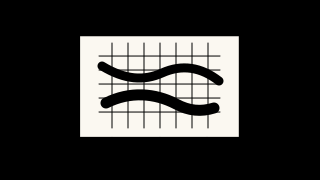
Canvas is a woven fabric support used for paintings, banners, bags, décor, and other projects. Artist canvas may be raw, sized, acrylic-primed, oil-primed, or factory-coated, and each condition changes how paint absorbs and bonds.

Paper is an absorbent sheet material made primarily from cellulose fibers. Its weight, sizing, surface texture, and wet strength determine how much paint it can accept before buckling, pilling, bleeding, or warping.
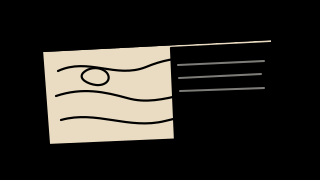
Wood is a natural, porous material with grain patterns and absorbency that vary by species and cut. Its surface may also contain knots, resin, or an existing finish.

Fabric is a flexible material made by weaving, knitting, or bonding fibers. Its fiber content, texture, stretch, and washability affect how paint bonds and wears.

Plywood is an engineered wood panel made from bonded veneer layers with alternating grain, and its faces, edges, and filled areas absorb paint differently.

Plaster is a porous mineral wall and ceiling finish that may be based on gypsum, lime, or other binders. Fresh plaster contains significant moisture and can be highly absorbent until fully dry and appropriately sealed.

Metal surfaces are hard and nonporous, but their behavior varies by material. Steel and iron can rust, while aluminum forms an oxide layer.
Explore painters similar to Jasper Johns through postwar American art, repeated symbols, commercial imagery, geometric structure, and unconventional materials.

Andy Warhol was an American Pop artist known for transforming consumer products, celebrities, and mass-media photographs into paintings and repeated screen-printed images.

Roy Lichtenstein was an American Pop artist known for adapting comic-book and advertising imagery into paintings using bold outlines, flat color, and patterns inspired by commercial printing.

Frank Stella was an American artist known for abstract painting and extensive use of industrial coatings, including alkyd, epoxy, urethane, fluorescent, and antifouling paints.