
Oil Paint
Oil paint is a slow-drying paint made with pigment and a drying oil binder. It is widely used for artwork because it blends smoothly and develops rich color.

Painter
Frank Stella was an American artist known for abstract painting and extensive use of industrial coatings, including metallic, alkyd, epoxy, urethane, fluorescent, and antifouling paints, alongside acrylic, watercolor, and gouache work.
Stella’s early Black Paintings helped anticipate Minimalist painting and broke with the gestural approach of Abstract Expressionism. His later work moved beyond Minimalism into shaped supports and industrial paints.
| Born | 1936 · Malden, Massachusetts, U.S. |
|---|---|
| Died | 2024 · New York, U.S. |
| Nationality | American |
| Movements | Minimalism (early stripe paintings) and Post-Painterly Abstraction |
| Paint types | Oil paint · Acrylic paint · Alkyd paint · Enamel paint · Metallic paint · Epoxy paint · Urethane paint · Fluorescent paint · Antifouling paint · Watercolor · Gouache · synthetic polymer paint |
| Painting surfaces | Canvas · Paper · Cardboard · Wood · Aluminum · Fiberglass |
| Painting methods | Freehand, brush-width stripes generated systematically from the canvas shape; later layered relief construction |
| Common subjects | Stripes, shaped canvases, geometric systems, relief-like constructions, arcs, bands, and increasingly sculptural painted structures |
| Known for | Moving from austere early geometric paintings into large, layered works combining painting, relief, industrial materials, vivid synthetic color, and works on paper |
| Notable works | The Marriage of Reason and Squalor, II, Effingham II, and Giufà, la luna, i ladri e le guardie |
Sources: Museum of Modern Art, MoMA: Giufà, la luna, i ladri e le guardie, The Met: Untitled (Kufa Gate Shape), Whitney Museum: Frank Stella retrospective, Allen Memorial Art Museum: Wolfeboro, Museum of Fine Arts, Houston: Frank Stella works, MoMA: Alkyd enamel paint, and Menil Collection Artist Documentation Program, and National Gallery of Art: Them Apples.
See the paint types documented in Stella's work, with links to PaintZeal references explaining each medium's properties, uses, and working characteristics.
Oil paint is a slow-drying paint made with pigment and a drying oil binder. It is widely used for artwork because it blends smoothly and develops rich color.
Acrylic paint is a fast-drying, water-based paint made with pigment and an acrylic polymer binder. It is widely used in art and decorative projects because it is versatile and durable.

Alkyd paint is a resin-based coating that levels into a smooth, durable finish. It is available in traditional solvent-based formulas and newer waterborne versions.
Enamel paint is a broad category of coatings designed to form a hard and durable finish. Modern enamels may use either oil-based or water-based binders.

Metallic paint contains reflective particles that create a metal-like shimmer or sheen. Products range from decorative water-based wall paints to specialty coatings and aerosols, so surface preparation and durability depend on the exact formula.
Epoxy paint is a durable coating based on epoxy resin. Two-part formulas combine resin and hardener before application, while one-part products are usually epoxy-modified paints.

Polyurethane paint is a resin-based coating that forms a tough and durable finish. Formulas range from clear wood finishes to pigmented industrial coatings.

Fluorescent paint uses highly vivid pigments that appear especially bright under strong light and ultraviolet illumination. Unlike glow-in-the-dark paint, it does not continue glowing after the light source is removed.

Antifouling paint is an underwater marine coating formulated to deter fouling organisms such as barnacles, weeds, and slime from attaching to a boat hull. Formulas include hard, ablative, polishing, copper-based, and copper-free systems, so the exact product must match the hull material and water conditions.

Watercolor paint is a water-based art medium made with pigment and a water-soluble binder. It is known for transparent color that settles into absorbent paper.

Gouache paint is an opaque, water-based art medium made with pigment and a water-soluble binder. Traditional formulas dry to a matte finish and can be reactivated with water.
See the surface types documented in Stella's work, with links to PaintZeal references explaining how each support behaves and is prepared for painting.
Canvas is a woven fabric support used for paintings, banners, bags, décor, and other projects. Artist canvas may be raw, sized, acrylic-primed, oil-primed, or factory-coated, and each condition changes how paint absorbs and bonds.

Paper is an absorbent sheet material made primarily from cellulose fibers. Its weight, sizing, surface texture, and wet strength determine how much paint it can accept before buckling, pilling, bleeding, or warping.

Cardboard is a paper-based sheet material made from compressed fibers, often with corrugated fluting between liner sheets. It is lightweight and absorbent, so heavy wet coats can soften or warp it.
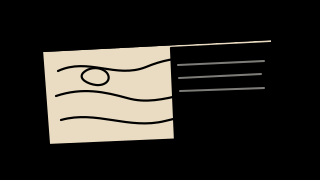
Wood is a natural, porous material with grain patterns and absorbency that vary by species and cut. Its surface may also contain knots, resin, or an existing finish.

Aluminum is a lightweight, nonferrous metal that quickly forms a thin oxide layer when exposed to air. This layer protects the metal but changes how coatings bond.

Fiberglass is a composite material made from glass fibers embedded in resin. Finished pieces usually have a smooth resin or gelcoat surface rather than exposed fibers.
Explore painters similar to Frank Stella through geometric abstraction, industrial paints, shaped supports, synthetic color, works on paper, and process-driven postwar painting.

Peter Halley is an American painter known for geometric images of cells, prisons, and conduits built from fluorescent Day-Glo acrylic color and deliberately artificial commercial textures.

Bridget Riley is a British painter known for abstract compositions that create optical movement through repeated lines, curves, shapes, and structured color relationships.
Christopher Wool is an American painter known for black enamel paintings, especially works on white aluminum panels made with stencils, patterned rollers, screens, and spray paint.

Tom Holland is an American painter and sculptor known for works combining painting with shaped aluminum or fiberglass, often finished with epoxy paint, as well as works in watercolor and other media.