Enamel Paint
Enamel paint is a broad category of coatings designed to form a hard and durable finish. Modern enamels may use either oil-based or water-based binders.
Painter
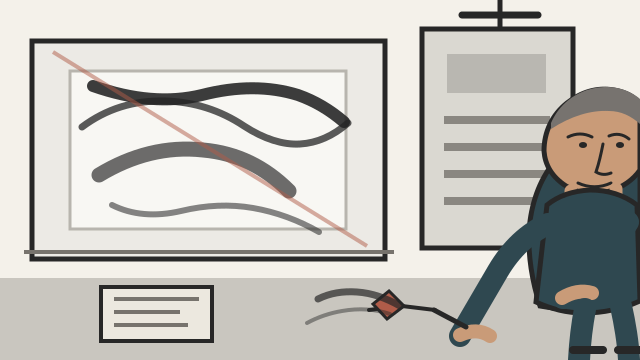
Christopher Wool is an American painter known for black enamel paintings, especially works on white aluminum panels made with stencils, patterned rollers, screens, and spray paint.
Review key details about Christopher Wool's career, black enamel paintings, aluminum supports, stencils, rollers, screens, and spray techniques that shaped his practice.
| Born | September 16, 1955 · Chicago, Illinois, U.S. |
|---|---|
| Died | — |
| Nationality | American |
| Movements | Post-conceptualism and contemporary abstraction |
| Paint types | Enamel paint · Acrylic paint · Spray paint · Oil paint |
| Painting surfaces | Aluminum panels · Linen · Paper · Board |
| Application tools | Rubber stamps · Stencils · Decorative rollers · Screens · Spray equipment |
| Painting methods | Pattern transfer, stenciled text, screenprinting, spraying, wiping, and overpainting |
| Common subjects | Stenciled words, repeated floral and geometric patterns, black marks, erasures, and abstract gestures |
| Known for | Black marks, repeated patterns, text, and process-driven abstraction using commercial materials |
| Notable works | Apocalypse Now · He Said She Said · Static |
Sources: Whitney Museum of American Art, Solomon R. Guggenheim Museum, SFMOMA: Untitled (1989), MoMA: Untitled (1990), MoMA: Untitled (1989), MoMA: Untitled (1991), and Galerie Max Hetzler selected works.
See the paint types documented in Wool's work, with links to PaintZeal references explaining each medium's properties, uses, and working characteristics.
Enamel paint is a broad category of coatings designed to form a hard and durable finish. Modern enamels may use either oil-based or water-based binders.
Acrylic paint is a fast-drying, water-based paint made with pigment and an acrylic polymer binder. It is widely used in art and decorative projects because it is versatile and durable.

Spray paint is a liquid coating packaged in a pressurized can and applied as a fine aerosol. It creates an even finish without requiring a brush or roller.
Oil paint is a slow-drying paint made with pigment and a drying oil binder. It is widely used for artwork because it blends smoothly and develops rich color.
See the surface types documented in Wool's work, with links to PaintZeal references explaining how each support behaves and is prepared for painting.

Aluminum is a lightweight, nonferrous metal that quickly forms a thin oxide layer when exposed to air. This layer protects the metal but changes how coatings bond.

Linen is a strong woven fabric made from flax fibers and commonly used as a support for fine-art painting. Artist linen may be sold raw or prepared with a ground layer.
Paper is an absorbent sheet material made primarily from cellulose fibers. Its weight, sizing, surface texture, and wet strength determine how much paint it can accept before buckling, pilling, bleeding, or warping.

Painting board is a rigid artist support made from hardboard, wood, or another stable panel material. It may be sold raw or prepared with a medium-specific ground layer.
Explore painters similar to Christopher Wool through commercial paints, unconventional tools, repeated marks, erasure, spray processes, and industrial materials.

Gary Simmons is an American artist known for drawing on chalkboard-like painted grounds and then smearing or erasing the image to create blurred, partially removed forms.
Molly Zuckerman-Hartung is an American painter known for abstract works combining latex house paint, enamel, spray paint, cut and sewn drop cloth, and other studio materials.

Billy Al Bengston was an American painter associated with postwar Los Angeles who adapted automotive lacquer, enamel, aluminum, and high-gloss finishing methods to fine-art painting.
Frank Stella was an American artist known for abstract painting and extensive use of industrial coatings, including alkyd, epoxy, urethane, fluorescent, and antifouling paints.