Acrylic Paint
Acrylic paint is a fast-drying, water-based paint made with pigment and an acrylic polymer binder. It is widely used in art and decorative projects because it is versatile and durable.
Painting Movement
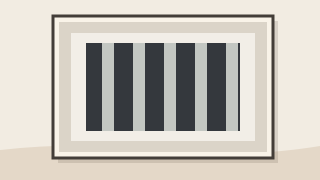
Minimalism favored simple forms, repetition, and restraint, challenging expressive gesture and illusion in painting as well as sculpture.
Minimalism simplified geometry and emphasized repetition, materials, and scale across art forms; painting was an important but smaller component of the movement.
| Origin | United States, with international parallels |
|---|---|
| Approximate period | 1960s–1970s, with continuing influence |
| Context | Developed in the 1960s partly in reaction against expressive abstraction |
| Defining characteristics | Reduced visual vocabulary, geometry, serial forms, and close attention to the actual painted surface |
| Scope | Minimalism is broadly associated with sculpture and installations as well as paintings; not all Minimalist artists worked in paint |
| Associated painters | Jo Baer, Agnes Martin, Robert Ryman, and Frank Stella (whose early stripe paintings anticipated the style) |
| Representative works | Jo Baer's Double-Bar, Grey (Green Line) (1968) and Stella's The Marriage of Reason and Squalor, II (1959) |
| Materials and methods | Repeated painted units, restrained colors, and carefully applied surfaces; some used commercial coatings and supports |
| Supports | Canvas and rigid panels, with painting materials varying by artist |
Sources: MoMA: Minimalism, MoMA: Materials of Minimalism, MoMA: Jo Baer’s Double-Bar, Grey (Green Line).
Acrylic, oil, and flat coatings support deliberate edges and repeated shapes; gouache and paint markers can help lay out precise reduced compositions.
Acrylic paint is a fast-drying, water-based paint made with pigment and an acrylic polymer binder. It is widely used in art and decorative projects because it is versatile and durable.

Oil paint is a slow-drying paint made with pigment and a drying oil binder. It is widely used for artwork because it blends smoothly and develops rich color.

Enamel paint is a broad category of coatings designed to form a hard and durable finish. Modern enamels may use either oil-based or water-based binders.

Alkyd paint is a resin-based coating that levels into a smooth, durable finish. It is available in traditional solvent-based formulas and newer waterborne versions.
Latex paint is a water-based architectural coating made with a synthetic polymer binder and commonly used on interior and exterior building surfaces.

Acrylic gouache is an opaque acrylic paint that dries to a flat matte finish while forming a permanent, water-resistant film unlike traditional gouache.

Gouache paint is an opaque, water-based art medium made with pigment and a water-soluble binder. Traditional formulas dry to a matte finish and can be reactivated with water.
Paint markers deliver opaque pigmented color through a marker tip, with water- and oil-based formulas varying in permanence and surface compatibility.
Minimalist painting is a narrower topic than Minimalism as a whole. Stella's stripe paintings were influential precursors, not a model for every later artist.
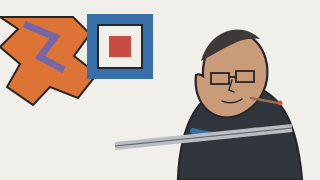
Frank Stella was an American artist known for abstract painting and extensive use of industrial coatings, including metallic, alkyd, epoxy, urethane, fluorescent, and antifouling paints, alongside acrylic, watercolor, and gouache work.
| Painter | Contribution |
|---|---|
| Jo Baer | Bands of color and negative space emphasizing the edges of the canvas |
| Agnes Martin | Faint grids and repeated marks in calm, subtle tones |
| Robert Ryman | Monochrome white paintings exploring the materials, support, and physical surface |
Minimalism shared a reduced palette with Color Field Painting and geometric systems with Op Art and De Stijl, but generally rejected optical spectacle and gestural emotion.
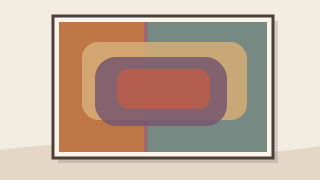
Color Field Painting uses expansive, often unbroken color areas to create a sense of scale, atmosphere, and direct visual experience.
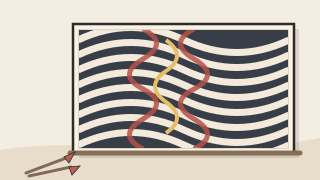
Op Art became prominent in the 1960s, using repeated geometric shapes, lines, and color contrasts to make still paintings appear to vibrate, move, or recede.
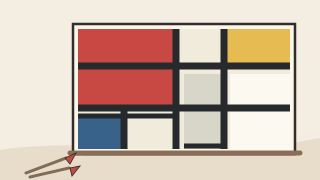
De Stijl began in the Netherlands in 1917, bringing artists together around simple geometric forms, straight lines, and clear primary colors.