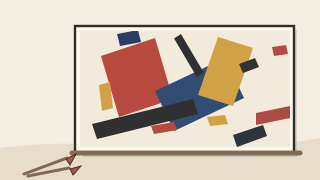
Suprematism
Suprematism emerged in the Russian avant-garde in 1915, using simple geometric shapes and pure color to make paintings free from recognizable subjects.
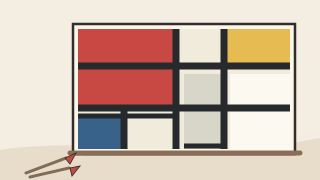
Painting Movement
De Stijl began in the Netherlands in 1917, bringing artists together around simple geometric forms, straight lines, and clear primary colors.
The movement sought harmony through a reduced visual vocabulary and extended its ideas from painting into architecture and everyday design.
| Origin | Netherlands |
|---|---|
| Approximate period | 1917–1931, with influence continuing afterward |
| Dutch name | De Stijl, meaning “The Style” |
| Founding publication | The journal De Stijl, established by Theo van Doesburg in 1917 |
| Key painters | Piet Mondrian, Theo van Doesburg, Bart van der Leck, and Vilmos Huszár |
| Defining characteristics | Rectangular planes, vertical and horizontal lines, asymmetrical balance, and simplified color |
| Typical colors | Red, yellow, blue, black, white, and gray; individual artists and periods varied |
| Artistic aim | Visual order and balance expressed through abstract relationships rather than observed subjects |
| Neo-Plasticism | Mondrian's closely related theory of abstract painting, also called Nieuwe Beelding; not a synonym for every work associated with De Stijl |
| Later variation | Van Doesburg's Elementarism introduced diagonals, departing from Mondrian's insistence on horizontals and verticals |
| Other disciplines | Architecture, furniture, graphic design, and applied arts as well as painting |
| Paint medium | Oil paint was among the media used for paintings |
| Painting surfaces | Canvas and other supports depending on the work |
Sources: MoMA: De Stijl, MoMA: Neo-Plasticism, and Routledge Encyclopedia of Modernism: De Stijl.
Mondrian developed a strict abstract vocabulary, van Doesburg connected the movement's artists, and van der Leck explored flat colored forms.
| Painter | Known for | Representative work |
|---|---|---|
| Piet Mondrian | Grids, primary colors, asymmetrical balance, and Neo-Plasticist theory | Composition No. II, with Red and Blue (1929) |
| Theo van Doesburg | Founding and editing the journal; abstract painting and later diagonal compositions | Rhythm of a Russian Dance (1918) |
| Bart van der Leck | Flat primary-color planes, simplified shapes, and independent abstract experiments | Untitled (1917) |
| Vilmos Huszár | Early De Stijl designs, abstract painting, and graphic composition | Cover design for De Stijl (1917) |
Source: MoMA: De Stijl, selected works.
De Stijl shared geometric abstraction with Suprematism but pursued a distinctive balance of lines, rectangles, and primary-color planes.
Suprematism emerged in the Russian avant-garde in 1915, using simple geometric shapes and pure color to make paintings free from recognizable subjects.

Cubism emerged in Paris as Pablo Picasso and Georges Braque broke objects and figures into angular planes, compressed space, and shifting viewpoints.
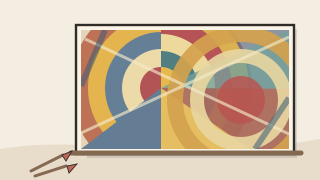
Orphism emerged around 1912 in Paris as painters developed colorful, rhythmic abstraction from Cubism, exploring how light and color interact.