
Piet Mondrian
Piet Mondrian was a Dutch abstract painter known for balanced compositions of straight black lines, rectangular color planes, and white space.
Painter
Bart van der Leck was a Dutch De Stijl painter known for isolated primary-colored shapes, white grounds, and abstract designs rooted in observed life.
Van der Leck moved from depicting workers toward highly reduced red, blue, and yellow forms, while retaining a connection with recognizable subjects.
| Full name | Bart Anthony van der Leck |
|---|---|
| Born | 1876 · Utrecht, Netherlands |
| Died | 1958 · Blaricum, Netherlands |
| Nationality | Dutch |
| Movements | De Stijl (founding member; brief association) |
| Paint types | Oil Paint · Gouache Paint |
| Other media | Lithography · design |
| Other materials | — |
| Painting surfaces | Canvas · Paper |
| Painting methods | Planned geometric arrangements in opaque gouache on tracing paper and painted sharply bounded color areas |
| Common subjects | Working people, workers and fishermen, landscapes reduced to colored shapes, and geometric arrangements |
| Notable works | Study for Compositions No. 7 and No. 8 · Woodhackers · Composition 1917, No. 4 |
Sources: Museo Thyssen-Bornemisza: Van der Leck biography, Museo Thyssen-Bornemisza: Study for Compositions No. 7 and No. 8, gouache on tracing paper, Museo Thyssen-Bornemisza: Woodhackers, oil on canvas, Museum.nl: Composition 1917 No. 4, oil on canvas, and RKD: Bart van der Leck media and practice.
Van der Leck used oil for finished paintings and gouache for studies on tracing paper; examples distinguish the media and their role in simplifying forms.

Van der Leck’s Woodhackers (1927) is oil on canvas. The painting simplifies workers and their tools into broad, sharply separated shapes while retaining enough figurative detail to identify the labor scene. This work documents his use of oil in a mature composition, distinct from the gouache studies on tracing paper made a decade earlier.
In Study for Compositions No. 7 and No. 8 (1917), van der Leck applied gouache to tracing paper, reducing a landscape into rectangles and colored lines while faint mountain forms remain visible. The opaque paint lets him test a simplified composition on a translucent sheet. This study differs from the completed oil painting Woodhackers.
Sources: Museo Nacional Thyssen-Bornemisza: Woodhackers (1927), oil on canvas; Museo Nacional Thyssen-Bornemisza: Study for Compositions No. 7 and No. 8 (1917), gouache on tracing paper.; Museo Thyssen-Bornemisza: Bart van der Leck biography; Kröller-Müller Museum: Composition 1917 No. 4
Van der Leck painted in oil on canvas and made gouache studies on tracing paper; the examples separate finished landscapes from preparatory studies.
The Museo Thyssen-Bornemisza catalogs Woodhackers as an oil painting on canvas. Its textile support carries van der Leck’s simplified workers and color blocks in a finished composition. The canvas paintings are distinct from his preparatory studies on tracing paper, where he explored shape and color before completing larger works.
Van der Leck’s Study for Compositions No. 7 and No. 8 is gouache on tracing paper. The translucent sheet supports colored geometric forms while allowing faint underlying landscape marks to remain legible. Museum records document this paper-based study practice alongside his finished oil paintings on canvas.
Sources: Museo Thyssen-Bornemisza: Van der Leck biography, Museo Thyssen-Bornemisza: Study for Compositions No. 7 and No. 8, gouache on tracing paper, Museo Thyssen-Bornemisza: Woodhackers, oil on canvas, Museum.nl: Composition 1917 No. 4, oil on canvas.
Mondrian and van Doesburg shared De Stijl’s project with van der Leck, whose paintings kept recognizable subjects within the movement’s geometric style.
Piet Mondrian was a Dutch abstract painter known for balanced compositions of straight black lines, rectangular color planes, and white space.
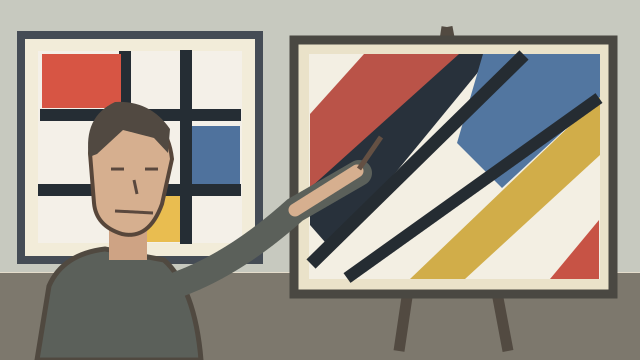
Theo van Doesburg was a Dutch painter and De Stijl founder who developed geometric abstractions of primary colors, bold lines, and later dynamic diagonals.