Piet Mondrian
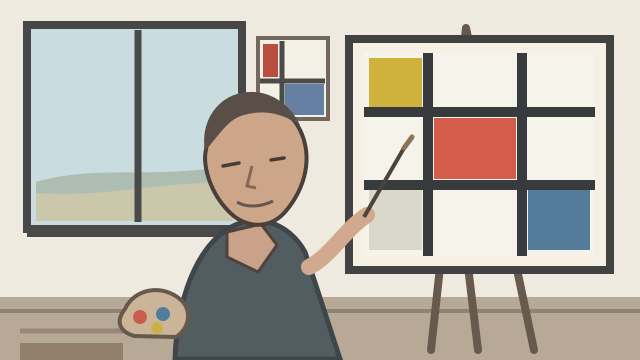
Piet Mondrian was a Dutch abstract painter known for balanced compositions of straight black lines, rectangular color planes, and white space.
Painter
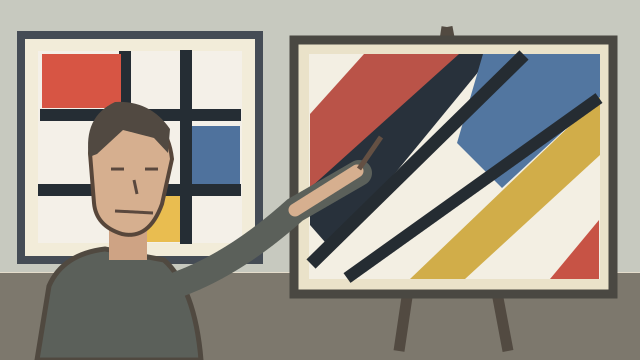
Theo van Doesburg was a Dutch painter and De Stijl founder who developed geometric abstractions of primary colors, bold lines, and later dynamic diagonals.
Van Doesburg founded the journal De Stijl in 1917 and later developed Elementarism by introducing diagonal relationships into geometric abstraction.
| Full name | Christian Emil Marie Küpper |
|---|---|
| Born | 1883 · Utrecht, Netherlands |
| Died | 1931 · Davos, Switzerland |
| Nationality | Dutch |
| Movements | De Stijl; Elementarism |
| Paint types | Oil paint · Gouache |
| Other media | — |
| Other materials | — |
| Painting surfaces | Canvas · Paper · Board |
| Painting methods | Painted geometric oil compositions using vertical, horizontal, and diagonal arrangements; separately made gouache architectural studies on tracing paper and board |
| Common subjects | Geometric forms, grids, diagonal arrangements, and architectural space |
| Notable works | Rhythm of a Russian Dance · Counter-Composition VII · Counter-Composition XIII · Construction in Space-Time II |
Sources: MoMA: Rhythm of a Russian Dance, oil on canvas, Museum De Lakenhal: Counter-Composition VII, oil on canvas, Guggenheim: Counter-Composition XIII, oil on canvas, Museo Thyssen-Bornemisza: Construction in Space-Time II, gouache on tracing paper, Guggenheim: Composition décentralisée, gouache on board.
Van Doesburg made dynamic De Stijl compositions in oil on canvas and used gouache on paper and board to explore architectural geometry and color.

Rhythm of a Russian Dance (June 1918), oil on canvas, translates the movement of a dancer into separated vertical and horizontal color planes. In Counter-Composition VII (1924), also oil on canvas, van Doesburg tilted a rectangular arrangement into a diamond-like relationship, an early move toward his more dynamic Elementarism.
Van Doesburg used gouache on tracing paper with pencil and ink for Construction in Space-Time II (1924), a geometric architectural design documented by the Thyssen-Bornemisza Museum. He also painted Composition décentralisée (1924) in gouache on board. These were experiments in painted spatial relationships and composition, but the drawn pencil and ink in the former work are not extra paint types.
Sources: MoMA: Rhythm of a Russian Dance, oil on canvas, Museum De Lakenhal: Counter-Composition VII, oil, Guggenheim: Counter-Composition XIII, oil on canvas, Museo Thyssen-Bornemisza: Construction in Space-Time II, gouache on tracing paper, and Guggenheim: Composition décentralisée, gouache on board.
Theo van Doesburg's documented works use canvas and paper; examples clarify whether each is the painted ground, support, or part of the object.
Van Doesburg’s geometric paintings, including Rhythm of a Russian Dance (1918), are documented on canvas. He used oil to translate dance movement into separated horizontal and vertical color planes, while later works such as Counter-Composition VII tilted the grid into more dynamic diagonal relationships.

Van Doesburg used paper for drawings and studies, including gouache architectural designs on tracing paper. The Thyssen-Bornemisza records Construction in Space-Time II (1924) as gouache, pencil, and ink on tracing paper, documenting a flexible support for plans and spatial experiments separate from his oil canvases.
Sources: MoMA: Rhythm of a Russian Dance, oil on canvas, Museum De Lakenhal: Counter-Composition VII, oil on canvas, Guggenheim: Counter-Composition XIII, oil on canvas, Museo Thyssen-Bornemisza: Construction in Space-Time II, gouache on tracing paper, Guggenheim: Composition décentralisée, gouache on board.
Mondrian shared the De Stijl project but favored vertical and horizontal lines; Malevich pursued a distinct geometric abstraction in Suprematism.
Piet Mondrian was a Dutch abstract painter known for balanced compositions of straight black lines, rectangular color planes, and white space.

Kazimir Malevich was a Kyiv-born avant-garde painter who founded Suprematism, reducing painting to geometric forms, color, and oil-paint texture.