
Oil Paint
Oil paint is a slow-drying paint made with pigment and a drying oil binder. It is widely used for artwork because it blends smoothly and develops rich color.
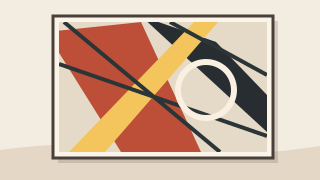
Painting Movement
Constructivism developed around revolutionary Russia, shifting from geometric experiments toward art and design intended for everyday social use.
An early twentieth-century Russian avant-garde movement that treated composition as construction and ultimately challenged the status of easel painting.
| Origin | Revolutionary Russia and the Soviet avant-garde |
|---|---|
| Approximate period | 1917–early 1920s (painting); broader movement into the 1930s |
| Alternate labels | Russian Constructivism; the broader Russian avant-garde also encompassed Suprematism, which is distinct |
| Visual language | Geometric planes, dynamic diagonals, structural arrangements, and non-illusionistic space |
| Context | The movement grew in the period around the 1917 Revolution and favored art connected with modern life and production |
| Historical distinction | Many Constructivists moved beyond autonomous painting into graphic design, typography, textiles, architecture, and objects |
| Notable artists | Aleksandr Rodchenko, Liubov Popova, Varvara Stepanova, El Lissitzky, and Vladimir Tatlin |
| Representative works | Popova's Painterly Architectonic (1917) and El Lissitzky's Proun 19D (1920 or 1921) |
| Original painting media | Oil-based painting and other materials varied; many iconic Constructivist works are prints, designs, or constructions rather than paintings |
| Painting surfaces | Canvas and wooden panels for paintings; other works used paper, fabric, metal, or three-dimensional supports |
Sources: MoMA: Constructivism.
Oil suits early painted constructions; modern acrylic, gouache, and precise opaque media help recreate flat planes and sharply arranged geometric forms.
Oil paint is a slow-drying paint made with pigment and a drying oil binder. It is widely used for artwork because it blends smoothly and develops rich color.
Acrylic paint is a fast-drying, water-based paint made with pigment and an acrylic polymer binder. It is widely used in art and decorative projects because it is versatile and durable.

Acrylic gouache is an opaque acrylic paint that dries to a flat matte finish while forming a permanent, water-resistant film unlike traditional gouache.

Gouache paint is an opaque, water-based art medium made with pigment and a water-soluble binder, drying to a matte finish that can be reactivated with water.
Modern tempera is an opaque, water-based art paint used for school and craft projects, drying quickly and differing from traditional egg tempera.
Paint markers deliver opaque pigmented color through a marker tip, with water- and oil-based formulas varying in permanence and surface compatibility.
These artists' practices crossed painting and design. Their later typography, textiles, and objects should not all be described as paintings.
| Artist | Contribution |
|---|---|
| Liubov Popova | Geometric painterly constructions; later shifted toward textile and stage design |
| Aleksandr Rodchenko | Experimented with nonobjective paintings before shifting into design and photography |
| El Lissitzky | Developed Proun compositions bridging painting, architecture, and graphic space |
| Varvara Stepanova | Worked across experimental painting, graphics, and textile design |
Constructivism shared geometric abstraction with Suprematism, but placed increasing emphasis on material construction and practical social purposes.
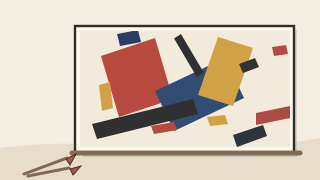
Suprematism emerged in the Russian avant-garde in 1915, using simple geometric shapes and pure color to make paintings free from recognizable subjects.
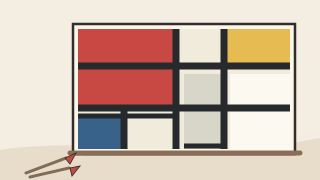
De Stijl began in the Netherlands in 1917, bringing artists together around simple geometric forms, straight lines, and clear primary colors.
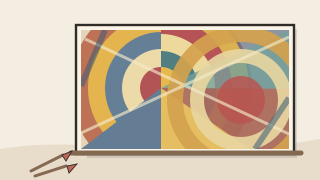
Orphism emerged around 1912 in Paris as painters developed colorful, rhythmic abstraction from Cubism, exploring how light and color interact.