
Oil Paint
Oil paint is a slow-drying art medium made with pigment and a drying-oil binder that allows extended working time, smooth blending, and layered application.
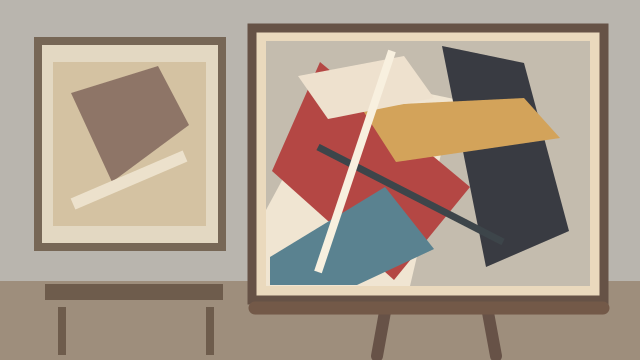
Painter
Liubov Popova was a Russian avant-garde painter known for overlapping geometric oil paintings and Painterly Architectonics before shifting toward textile and theatrical design.
Popova's abstract canvas paintings used colored planes as if constructed from interlocking parts. Her later clothing, textile, and stage designs are a separate applied-art practice rather than additional examples of oil painting.
| Born | 1889 · Ivanovskoe, Moscow Province, Russian Empire |
|---|---|
| Died | 1924 · Moscow, Soviet Union |
| Nationality | Russian |
| Movements | Constructivism · Suprematism · Cubo-Futurism |
| Paint types | Oil paint (documented for Painterly Architectonic, Architectonic Painting, and Man + Air + Space) |
| Painting surfaces | Canvas for major documented oil paintings |
| Painting methods | Overlapped angular colored planes, varied the apparent depth of geometric shapes, and treated painted composition as an architectonic assembly |
| Common subjects | Nonrepresentational tilted rectangles, interlocking planes, rhythm, color, and spatial tension |
| Notable works | Man + Air + Space (1913) · Painterly Architectonic (1917) · Architectonic Painting (1917) |
Sources: MoMA: Painterly Architectonic, LACMA: Architectonic Painting, State Russian Museum: Man + Air + Space, Städel Museum: Liubov Popova.
MoMA and LACMA independently document major 1917 paintings in oil on canvas; the State Russian Museum also records Man + Air + Space (1913) as oil on canvas. These sources do not imply that Popova's later fabric patterns or printed designs were paintings.
Oil paint is a slow-drying art medium made with pigment and a drying-oil binder that allows extended working time, smooth blending, and layered application.
The three documented oil paintings used canvas supports. Popova's later textile designs and stage projects involved other materials but belong to different forms of production and should not become painting-surface tiles here.

Canvas is a woven fabric support, commonly cotton or linen, used for painting and sold either raw or prepared with a compatible ground layer.
Rodchenko shared Popova's shift from experimental painting to socially oriented design; Malevich's Suprematist color planes were a direct influence on her Painterly Architectonics.
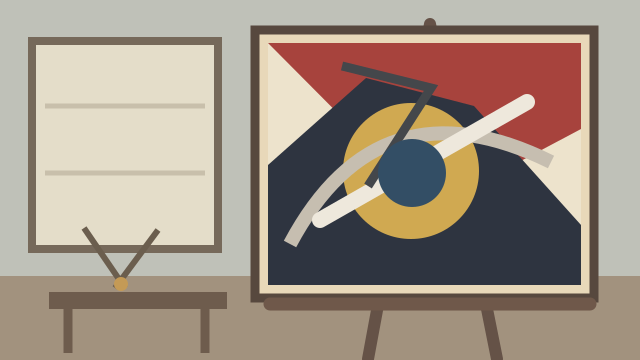
Aleksandr Rodchenko was a Russian avant-garde artist who experimented with geometric oil paintings, textured black-on-black canvases, and radical monochromes before concentrating on design and photography.

Kazimir Malevich was a Kyiv-born avant-garde painter who founded Suprematism, reducing painting to geometric shapes, color, and the texture of oil on canvas.