
Oil Paint
Oil paint is a slow-drying art medium made with pigment and a drying-oil binder that allows extended working time, smooth blending, and layered application.

Painter
Aleksandr Rodchenko was a Russian avant-garde artist who experimented with geometric oil paintings, textured black-on-black canvases, and radical monochromes before concentrating on design and photography.
Rodchenko's oil and bitumen paintings investigated the physical properties of pigment, surface, texture, and line. His 1921 red, yellow, and blue canvases marked a deliberate move away from conventional easel painting.
| Born | 1891 · Saint Petersburg, Russian Empire |
|---|---|
| Died | 1956 · Moscow, Soviet Union |
| Nationality | Russian |
| Movements | Constructivism · Russian avant-garde; dialogue with Suprematism |
| Paint types | Oil paint · bitumen combined with oil in Non-Objective Painting no. 80 (Black on Black) (1918) |
| Painting surfaces | Canvas (documented for 1918 and 1921 paintings) |
| Painting methods | Explored variation in black paint texture and finish, compass-drawn curves, geometric lines, and single-color canvases; later left easel painting for constructed objects and design |
| Common subjects | Nonrepresentational circles, arcs, lines, planar arrangements, and monochromatic color |
| Notable works | Non-Objective Painting no. 80 (Black on Black) (1918) · Red and Yellow (c. 1918) · Pure Red Color, Pure Yellow Color, Pure Blue Color (1921) |
Sources: MoMA: Black on Black, MoMA: The Death of Painting (1921 triptych), State Russian Museum: Red and Yellow, MoMA: Aleksandr Rodchenko.
MoMA specifies oil and bitumen on canvas for Non-Objective Painting no. 80 (Black on Black). Its Rodchenko exhibition identifies his 1921 primary-color triptych as oil on canvas. Bitumen is an additional material in the earlier work, not evidence for an unrelated modern paint category.
Oil paint is a slow-drying art medium made with pigment and a drying-oil binder that allows extended working time, smooth blending, and layered application.
Documented oil and bitumen paintings and the three monochrome canvases used fabric supports. His later plywood constructions, prints, and photographs should not be used to infer additional painting surfaces.

Canvas is a woven fabric support, commonly cotton or linen, used for painting and sold either raw or prepared with a compatible ground layer.
Stepanova worked closely with Rodchenko in Constructivist art and design; Popova likewise moved from geometric painting toward textile production, while Lissitzky developed Proun works between painting and architecture.
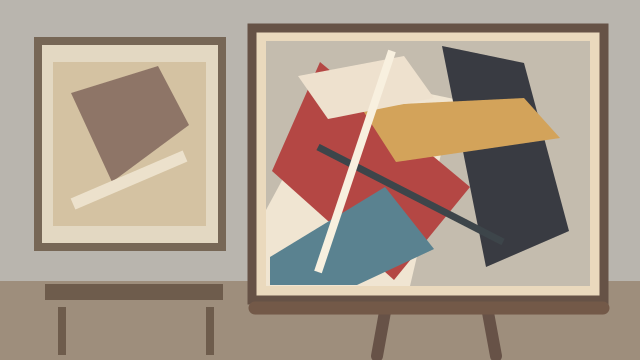
Liubov Popova was a Russian avant-garde painter known for overlapping geometric oil paintings and Painterly Architectonics before shifting toward textile and theatrical design.

El Lissitzky was a Russian artist, architect, and designer whose Proun compositions united geometric painting, collage, and architectural ideas.

Varvara Stepanova was a Russian avant-garde artist whose geometric oil paintings of figures evolved alongside her influential Constructivist work in textiles, clothing, and graphic design.