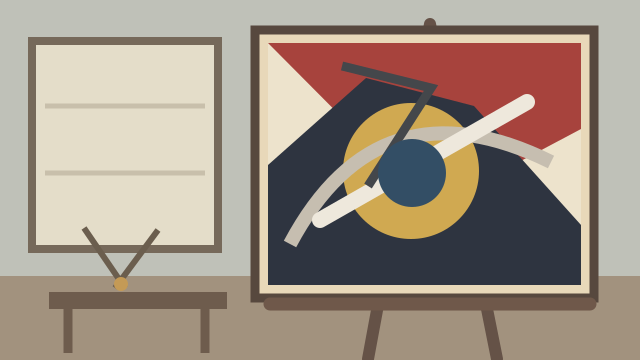
Aleksandr Rodchenko
Aleksandr Rodchenko was a Russian avant-garde artist who painted geometric oils and black monochromes before focusing on design and photography.

Painter
El Lissitzky was a Russian artist, architect, and designer whose Proun compositions united geometric painting, collage, and architectural ideas.
Lissitzky’s quick facts trace his Suprematist and Proun work across painting, architecture, typography, and experimental modern exhibition design.
| Full name | Lazar Markovich Lissitzky |
|---|---|
| Born | 1890 · Pochinok, Smolensk region, Russian Empire |
| Died | 1941 · Moscow, Soviet Union |
| Nationality | Russian |
| Movements | Constructivism · Suprematism |
| Paint types | Oil paint · metallic paint in Proun 19D · gouache in a 1923 Proun study |
| Other media | Photography · photomontage · exhibition design · architecture · book design · lithography |
| Other materials | — |
| Painting surfaces | Plywood for Proun 19D · Paper for gouache studies |
| Painting methods | Oil and metallic coatings combined with pasted papers and foil on plywood; gouache-and-graphite studies organizing imagined architectural space |
| Common subjects | Floating geometric volumes, diagonals, planes, perspective shifts, and imagined architectural space |
| Notable works | Proun 19D (1920 or 1921) · Proun R.V. (étude) (1923) · 1. Kestnermappe Proun (1923) |
Sources: MoMA: Proun 19D, Centre Pompidou: Proun R.V. (étude), National Galleries of Scotland: Proun lithograph, Museo Thyssen-Bornemisza: El Lissitzky, and MoMA: Dlia golosa (For the Voice).
Lissitzky combined oil and metallic paint with layered materials in Proun 19D, while using gouache in a separate architectural study on paper.
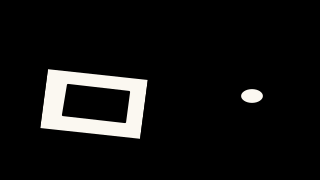
Proun 19D (1920 or 1921) combines oil paint with gesso, varnish, and paper collage on plywood. Lissitzky arranged circles, diagonals, and sharply angled planes to suggest architectural volumes floating in space. MoMA's catalogue distinguishes the oil from the varnish, paper, and applied metal foil; these latter materials are not additional types of paint.

MoMA also records metallic paint in Proun 19D, along with metal foil. Although both contribute reflective effects, metallic paint is applied as a coating whereas the foil is a separate sheet material. The mixed surface also contains cardboard, graph paper, sandpaper, and crayon, giving the geometric composition a physical complexity beyond its apparent flatness.
The Centre Pompidou identifies Proun R.V. (étude) (1923) as gouache and graphite on laid paper. In this much smaller study, solid painted planes and drawn lines organize a projected architectural space. It is a separate paper work, not a gouache layer documented in MoMA's mixed-media Proun 19D.
Sources: MoMA: Proun 19D, oil and metallic paint with collage on plywood, and Centre Pompidou: Proun R.V. (étude), gouache and graphite on paper.; Norton Simon Museum: El Lissitzky collection; Art Institute of Chicago: Proun, gouache and metallic paint
Collection records document plywood and paper in El Lissitzky’s practice, and each row links a support to a named object and its recorded materials.
Lissitzky’s Proun 19D (1920 or 1921) is a mixed-media work on plywood. MoMA records oil paint with gesso, varnish, paper collage, and metallic materials on the rigid engineered-wood support. The panel’s solidity supports his geometric planes and projected architectural forms, distinct from the paper used for studies.
Lissitzky’s gouache study Proun R.V. (étude) is made on laid paper, according to the Centre Pompidou. The sheet supports painted geometric planes and graphite lines. Paper studies are distinct from MoMA’s larger plywood relief-painting, and pasted collage papers are materials within a work rather than additional supports.
Sources: MoMA: Proun 19D, Centre Pompidou: Proun R.V. (étude), National Galleries of Scotland: Proun lithograph, Museo Thyssen-Bornemisza: El Lissitzky.
Rodchenko also explored constructed space and design beyond painting, while Malevich's Suprematist approach shaped Lissitzky's Proun compositions.
Aleksandr Rodchenko was a Russian avant-garde artist who painted geometric oils and black monochromes before focusing on design and photography.

Kazimir Malevich was a Kyiv-born avant-garde painter who founded Suprematism, reducing painting to geometric forms, color, and oil-paint texture.