Painting Movement
Suprematism
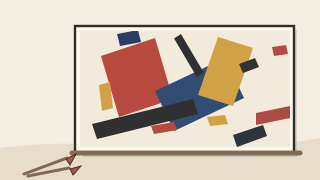
Suprematism emerged in the Russian avant-garde in 1915, using simple geometric shapes and pure color to make paintings free from recognizable subjects.
Suprematism quick facts
Malevich presented shapes floating against pale backgrounds as an alternative to pictures that depict objects, stories, or visible space.
| Origin | Russian Empire, with early activity in Moscow and Petrograd (now Saint Petersburg) |
|---|---|
| Approximate period | 1915–1920s, with later influence on abstract art and design |
| Name | Coined by Kazimir Malevich; describes the supremacy of pure artistic feeling over representation |
| Founder | Kazimir Malevich |
| Exhibition milestone | The Last Futurist Exhibition of Paintings 0.10 in Petrograd, December 1915 |
| Defining characteristics | Nonrepresentational geometric shapes, contrasting colors, and forms arranged without conventional perspective |
| Typical forms | Squares, rectangles, crosses, circles, and diagonal bands on white or neutral grounds |
| Leading painters | Kazimir Malevich, Olga Rozanova, and Ivan Kliun |
| Artistic aim | Painting based on color and form rather than copying the appearance of the physical world |
| Development | From strong colored shapes to increasingly minimal compositions such as Malevich's white-on-white paintings |
| Major works | Black Square (1915); Suprematist Composition: White on White (1918) |
| Paint medium | Oil paint, among others |
| Painting surfaces | Canvas, among other supports |
| Scope | A distinct approach to nonobjective painting, not a synonym for all geometric abstract art |
Sources: MoMA: Suprematism, MoMA: Malevich's 1915 painting, and MoMA: White on White.
Famous Suprematist painters
Malevich founded Suprematism, while Rozanova developed bold experiments with color and Kliun worked with simplified geometric arrangements.
| Painter | Known for | Representative work |
|---|---|---|
| Kazimir Malevich | Founding the movement and arranging geometric forms in nonrepresentational space | Suprematist Composition: White on White (1918) |
| Olga Rozanova | Exploring pure color through Suprematist composition and later radical simplification | Green Stripe (1917–1918) |
| Ivan Kliun | Small-format compositions of isolated geometric shapes against pale grounds | Composition (1917) |
Sources: MoMA: Malevich, Rostov Kremlin Museum: Rozanova's Green Stripe, and Museo Thyssen-Bornemisza: Ivan Kliun.
Related painting movements
Suprematism grew out of early avant-garde experiments but rejected depicting motion or recognizable objects in favor of independent shapes and color.
| Movement | How it differs |
|---|---|
| Futurism | Emphasized movement, machines, and modern life, whereas Suprematism rejected representation to explore nonobjective form. |
| Cubism | Fragmented recognizable subjects and space; Suprematist paintings typically abandoned the represented subject altogether. |
| Orphism | Also made color central to abstraction, but developed from Cubist-era experiments in light and rhythmic color relationships. |
Sources: MoMA: Suprematism and MoMA: Geometric abstraction.