
Oil Paint
Oil paint is a slow-drying art medium made with pigment and a drying-oil binder that allows extended working time, smooth blending, and layered application.

Painter
Vilmos Huszár was a Hungarian-born De Stijl painter and designer known for geometric color planes, abstract compositions, and graphic design.
Huszár helped launch De Stijl in 1917, designed its first cover, and moved between abstract painting, simplified figures, and applied design.
| Born | 1884 · Budapest, Austria-Hungary (now Hungary) |
|---|---|
| Died | 1960 · Hierden, Netherlands |
| Nationality | Hungarian-born Dutch |
| Movements | De Stijl (cofounder) |
| Paint types | Oil Paint |
| Painting surfaces | Canvas |
| Painting methods | Flat color planes, hard geometric divisions, reduced human silhouettes, and structured non-objective arrangements |
| Common subjects | Geometric compositions, human figures, card players, staged mechanical dancers, and abstract color relationships |
| Notable works | Baccarat Game · Composition 'De Stijl' · Composition with Female Figure |
| Related practice | Designed the first issue's cover for De Stijl and contributed to interiors, furniture, and graphic art |
Sources: Museo Thyssen-Bornemisza: Vilmos Huszár biography, Museo Thyssen-Bornemisza: Baccarat Game, oil on canvas, Kunstmuseum Den Haag: Composition 'De Stijl', oil on canvas, MoMA: Vilmos Huszár artworks.
Huszár's Baccarat Game and late Composition 'De Stijl' are documented oil paintings with simplified geometric forms.
Oil paint is a slow-drying art medium made with pigment and a drying-oil binder that allows extended working time, smooth blending, and layered application.
Museo Thyssen-Bornemisza and Kunstmuseum Den Haag identify canvas as the support for these oil paintings.

Canvas is a woven fabric support, commonly cotton or linen, used for painting and sold either raw or prepared with a compatible ground layer.
Huszár collaborated with van Doesburg and Mondrian on the De Stijl project, exploring similarly simplified geometry in painting and design.
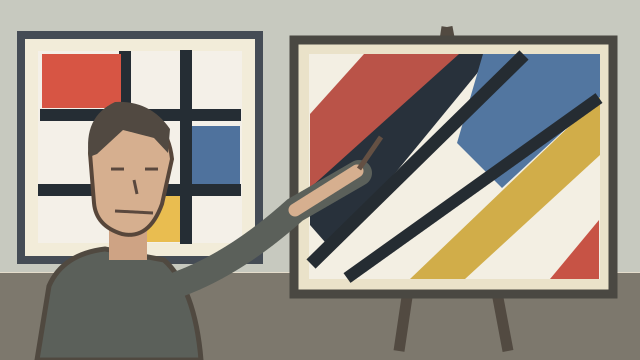
Theo van Doesburg was a Dutch painter and De Stijl founder who developed geometric abstractions of primary colors, bold lines, and later dynamic diagonals.

Piet Mondrian was a Dutch abstract painter known for balanced compositions of straight black lines, rectangular color planes, and white space.