
Oil Paint
Oil paint is a slow-drying paint made with pigment and a drying oil binder. It is widely used for artwork because it blends smoothly and develops rich color.
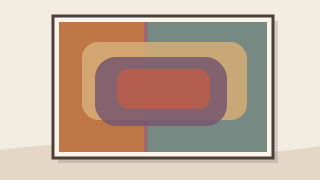
Painting Movement
Color Field Painting uses expansive, often unbroken color areas to create a sense of scale, atmosphere, and direct visual experience.
A major postwar approach to abstraction associated with, but not identical to, Abstract Expressionism.
| Origin | United States, especially New York |
|---|---|
| Approximate period | 1950s–1960s (later continuation) |
| Defining features | Large areas of color, reduced imagery, broad shapes, and little emphasis on a central subject |
| Historical relationship | Developed within and alongside Abstract Expressionism, often contrasting with visibly gestural action painting |
| Key painters | Mark Rothko, Barnett Newman, Helen Frankenthaler, Morris Louis, and Kenneth Noland |
| Approaches | Soft-edged color rectangles, vertical bands, poured stains, and large flat or transparent fields |
| Techniques | Thinned paint, staining into raw canvas, layering, and broad applications vary by artist |
| Representative works | Newman's Vir Heroicus Sublimis (1950–51) and Frankenthaler's Mauve District (1966) |
| Painting media | Oil and acrylic paint; specific binders, mixtures, and stain methods differed greatly |
| Painting surfaces | Large canvases, including unprimed canvas in some stain paintings |
Sources: MoMA: Color Field painting, MoMA: Newman’s Vir Heroicus Sublimis, MoMA: Frankenthaler’s Mauve District.
Oil and acrylic support saturated, layered fields; thinned watercolor or gouache can explore translucent color on suitable paper, while modern flat coatings offer other interpretations.
Oil paint is a slow-drying paint made with pigment and a drying oil binder. It is widely used for artwork because it blends smoothly and develops rich color.

Acrylic paint is a fast-drying, water-based paint made with pigment and an acrylic polymer binder. It is widely used in art and decorative projects because it is versatile and durable.

Watercolor paint is a water-based art medium made with pigment and a water-soluble binder. It is known for transparent color that settles into absorbent paper.

Gouache paint is an opaque, water-based art medium made with pigment and a water-soluble binder, drying to a matte finish that can be reactivated with water.

Acrylic gouache is an opaque acrylic paint that dries to a flat matte finish while forming a permanent, water-resistant film unlike traditional gouache.
Latex paint is a water-based architectural coating made with a synthetic polymer binder and commonly used on interior and exterior building surfaces.
Rothko layered softly edged colors, Newman set narrow vertical zips against expansive fields, and Frankenthaler stained canvas with thinned paint. Each developed a distinct Color Field process.
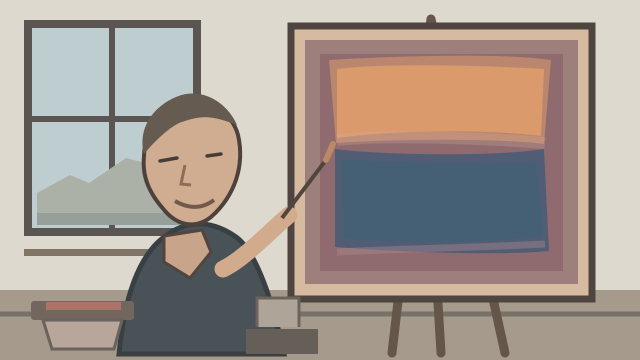
Mark Rothko was an American abstract painter known for large canvases with softly edged fields of color and a focus on the emotional impact of painting.

Barnett Newman was an American abstract painter known for vast, often monochromatic color fields interrupted by narrow vertical stripes he called zips.

Helen Frankenthaler was an American painter whose soak-stain technique helped reshape postwar abstraction by allowing thinned paint to soak directly into raw canvas.
| Artist | Contribution |
|---|---|
| Morris Louis | Veils and flowing stained colors on unprimed canvas |
| Kenneth Noland | Concentric circles, chevrons, and stripes organized by color |
Color Field Painting grew from postwar abstraction but shifted the emphasis toward sustained color relationships rather than the expressive action of a brush.
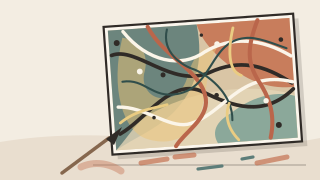
Abstract Expressionism emerged in postwar New York, where painters explored bold gestures, large canvases, and expansive fields of color.
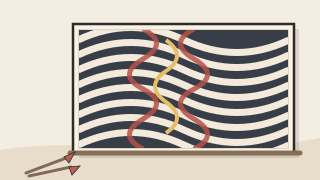
Op Art became prominent in the 1960s, using repeated geometric shapes, lines, and color contrasts to make still paintings appear to vibrate, move, or recede.

Pop Art drew on advertising, comic books, celebrities, and everyday products, bringing mass-media imagery into painting in Britain and the United States.