
Oil Paint
Oil paint is a slow-drying paint made with pigment and a drying oil binder. It is widely used for artwork because it blends smoothly and develops rich color.

Painter
Mark Rothko was an American abstract painter known for large canvases with softly edged fields of color and a focus on the emotional impact of painting.
Review Rothko's career, Abstract Expressionist and Color Field painting, large color compositions, and documented oil and acrylic materials.
| Birth name | Markus Rothkowitz |
|---|---|
| Born | September 25, 1903 · Dvinsk, Russian Empire (now Daugavpils, Latvia) |
| Died | February 25, 1970 · New York City, New York, U.S. |
| Nationality | American (born in the Russian Empire) |
| Movements | Abstract Expressionism · Color Field painting |
| Paint types | Oil paint · Acrylic paint |
| Painting surfaces | Canvas · Paper |
| Painting methods | Thin overlapping layers and softly blended color edges on large canvases; later acrylic paintings on paper and canvas |
| Common subjects | Early figures and city scenes; later luminous rectangles of color, often stacked vertically |
| Other media | Paintings on paper and site-specific mural commissions |
| Notable works | No. 10 (1950), the Seagram Murals, and the Rothko Chapel paintings |
Sources: National Gallery of Art: Mark Rothko, MoMA: Mark Rothko, MoMA: No. 10, oil on canvas, National Gallery of Art: Untitled, acrylic on paper, National Gallery of Art: Rothko Foundation works.
Explore the oil paints used in Rothko's mature canvases and the acrylic paints documented in his later work on canvas and paper.
Oil paint is a slow-drying paint made with pigment and a drying oil binder. It is widely used for artwork because it blends smoothly and develops rich color.

Acrylic paint is a fast-drying, water-based paint made with pigment and an acrylic polymer binder. It is widely used in art and decorative projects because it is versatile and durable.
Explore large canvases and the paper supports Rothko used throughout his career, including many late acrylic compositions.

Canvas is a woven fabric support used for paintings, banners, bags, décor, and other projects. Artist canvas may be raw, sized, acrylic-primed, oil-primed, or factory-coated, and each condition changes how paint absorbs and bonds.

Paper is an absorbent sheet material made primarily from cellulose fibers. Its weight, sizing, surface texture, and wet strength determine how much paint it can accept before buckling, pilling, bleeding, or warping.
Explore artists connected to Rothko through postwar abstraction, fields of color, and expressive ways of working with paint.
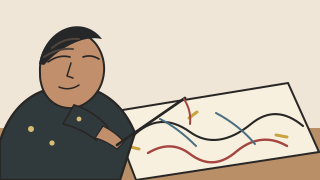
Jackson Pollock was an American Abstract Expressionist known for pouring, dripping, and flinging fluid paint across canvases laid on the floor.

Helen Frankenthaler was an American painter whose soak-stain technique helped reshape postwar abstraction by allowing thinned paint to soak directly into raw canvas.

Wassily Kandinsky was a Russian-born painter, teacher, and theorist known for abstract compositions exploring relationships among color, line, shape, and rhythm.