
Oil Paint
Oil paint is a slow-drying paint made with pigment and a drying oil binder. It is widely used for artwork because it blends smoothly and develops rich color.

Painter
Wassily Kandinsky was a Russian-born painter, teacher, and theorist known for abstract compositions exploring relationships among color, line, shape, and rhythm.
Review key details about Wassily Kandinsky's life, career, teaching, abstract practice, and the ideas about color, form, and music that shaped his work.
| Born | 1866 · Moscow, Russian Empire |
|---|---|
| Died | 1944 · Neuilly-sur-Seine, France |
| Nationality | Russian-born; later French |
| Movements | Expressionism, Der Blaue Reiter, Bauhaus, and abstraction |
| Paint types | Oil paint · Watercolor · Gouache · Tempera |
| Painting surfaces | Canvas · Paper · Painting board · Cardboard · Wood · Plywood · Glass |
| Painting methods | Preparatory drawings and watercolor studies developed into layered arrangements of color, line, and geometric form |
| Other media | Ink, drawing, woodcut, lithography, and drypoint |
| Common subjects | Early landscapes and folklore, followed by increasingly abstract arrangements of color, geometry, line, and biomorphic form |
| Notable works | Picture with an Archer, Composition VII, the Campbell Panels, and White – Soft and Hard |
Sources: The Museum of Modern Art, MoMA: Picture with an Archer, MoMA: White – Soft and Hard, MoMA: Church at Murnau, Museo Nacional Thyssen-Bornemisza: Murnau: Top of the Johannisstrasse, Solomon R. Guggenheim Museum: Watercolors by Kandinsky, and Guggenheim: Vasily Kandinsky Research Project.
See the paint types documented in Kandinsky's work, with links to PaintZeal references explaining each medium's properties, uses, and working characteristics.
Oil paint is a slow-drying paint made with pigment and a drying oil binder. It is widely used for artwork because it blends smoothly and develops rich color.
Watercolor paint is a water-based art medium made with pigment and a water-soluble binder. It is known for transparent color that settles into absorbent paper.
Gouache paint is an opaque, water-based art medium made with pigment and a water-soluble binder. Traditional formulas dry to a matte finish and can be reactivated with water.

Traditional tempera is an artist paint made by combining pigment with an emulsion binder. Egg yolk is the best-known traditional binder, but the broader tempera category can include other emulsion recipes, so a museum record that says only “tempera” does not always identify the exact binder.
See the surface types documented in Kandinsky's work, with links to PaintZeal references explaining how each support behaves and is prepared for painting.
Canvas is a woven fabric support used for paintings, banners, bags, décor, and other projects. Artist canvas may be raw, sized, acrylic-primed, oil-primed, or factory-coated, and each condition changes how paint absorbs and bonds.

Paper is an absorbent sheet material made primarily from cellulose fibers. Its weight, sizing, surface texture, and wet strength determine how much paint it can accept before buckling, pilling, bleeding, or warping.

Painting board is a rigid artist support made from hardboard, wood, or another stable panel material. It may be sold raw or prepared with a medium-specific ground layer.

Cardboard is a paper-based sheet material made from compressed fibers, often with corrugated fluting between liner sheets. It is lightweight and absorbent, so heavy wet coats can soften or warp it.
Wood is a natural, porous material with grain patterns and absorbency that vary by species and cut. Its surface may also contain knots, resin, or an existing finish.
Plywood is an engineered wood panel made from bonded veneer layers with alternating grain. Its faces, exposed edges, patches, and filled areas can absorb coatings differently.
Glass is a hard, smooth, nonporous material with very low absorbency and limited mechanical grip for paint. Fingerprints, soap film, polish, dust, and other invisible residues can also interfere with adhesion.
Explore painters similar to Wassily Kandinsky through abstraction, color theory, geometric form, expressive rhythm, Bauhaus ideas, and modernist experimentation.
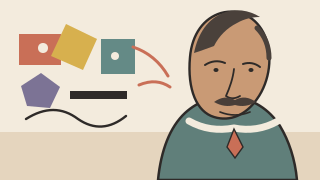
Paul Klee was a Swiss-born German artist and Bauhaus teacher whose highly experimental work combined color, geometry, symbols, humor, music, and observations of nature.
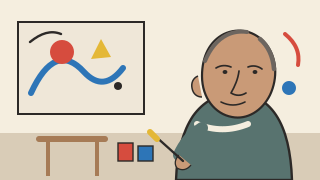
Joan Miró was a Spanish artist associated with Surrealism, known for biomorphic forms, symbolic imagery, vivid color, and abstract compositions across painting and printmaking.