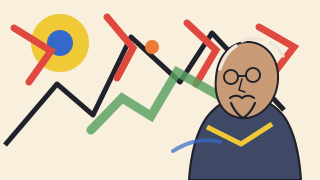
Wassily Kandinsky
Wassily Kandinsky was a Russian-born painter, teacher, and theorist known for abstract compositions exploring relationships among color, line, shape, and rhythm.

Painting Movement
Expressionism grew in early twentieth-century Germany and Austria, using distorted forms, intense color, and bold compositions to express emotional experience.
Expressionist artists often placed mood and subjective experience above realistic appearances, working in distinct groups rather than a single visual style.
| Origins | Germany and Austria, with international connections and precedents |
|---|---|
| Approximate period | 1905–early 1920s |
| German name | Expressionismus |
| Defining characteristics | Distorted or simplified figures, heightened color, bold lines, and subjective viewpoints |
| Common subjects | Modern city life, portraits, landscapes, spirituality, anxiety, and war |
| Die Brücke (The Bridge) | Founded in Dresden in 1905; associated with Ernst Ludwig Kirchner, Erich Heckel, and Karl Schmidt-Rottluff |
| Der Blaue Reiter (The Blue Rider) | Formed in Munich in 1911; associated with Wassily Kandinsky, Franz Marc, and Paul Klee |
| Other notable painters | Egon Schiele, Oskar Kokoschka, and Gabriele Münter |
| Painting methods | Loose or angular brushwork, non-naturalistic color, strong contours, and experimental composition |
| Paint types | Oil paint, watercolor, and gouache, depending on the artist |
| Related media | Woodcuts, lithography, drawing, and other printmaking |
| Representative paintings | Kirchner's Street, Dresden and Franz Marc's Horses Resting |
Sources: MoMA: Expressionism, MoMA: Die Brücke, and MoMA: Der Blaue Reiter.
Kirchner, Kandinsky, and Schiele explored very different forms of expression, while Klee worked in the circles around Der Blaue Reiter.
Wassily Kandinsky was a Russian-born painter, teacher, and theorist known for abstract compositions exploring relationships among color, line, shape, and rhythm.
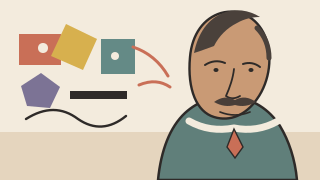
Paul Klee was a Swiss-born German artist and Bauhaus teacher whose highly experimental work combined color, geometry, symbols, humor, music, and observations of nature.
Fauvism shared Expressionism's strong color, while Abstract Expressionism emerged decades later in New York with a focus on gestural abstraction.
| Movement | How it differs |
|---|---|
| Fauvism | A shorter-lived French movement focused on intense, non-naturalistic color, without Expressionism's broader range of emotional and social concerns. |
| Abstract Expressionism | A distinct postwar movement centered in New York in the 1940s and 1950s, emphasizing expressive abstraction on often large canvases. |
Sources: MoMA: Expressionism and modern life, MoMA: Abstract Expressionism, and MoMA: Fauvism.