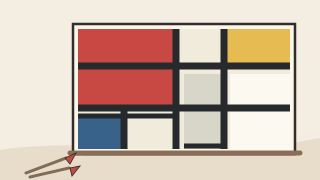
De Stijl
De Stijl began in the Netherlands in 1917, bringing artists together around simple geometric forms, straight lines, and clear primary colors.
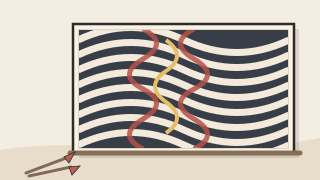
Painting Movement
Op Art became prominent in the 1960s, using repeated geometric shapes, lines, and color contrasts to make still paintings appear to vibrate, move, or recede.
Artists arranged lines, repeated forms, and contrasting colors to challenge the eye, often creating the impression of flicker, depth, or movement on a flat surface.
| Origins | International developments, especially in Europe and the United States |
|---|---|
| Approximate period | 1950s origins; widespread prominence in the 1960s |
| Full name | Optical Art, commonly shortened to Op Art |
| Defining characteristics | Repetition, geometric order, high contrasts, optical vibration, and illusionistic movement or depth |
| Typical forms | Stripes, grids, circles, curves, and patterned color fields |
| Visual effects | Apparent swelling, shifting, flickering, or recession without physical movement of the painting |
| Public milestone | MoMA's 1965 exhibition The Responsive Eye helped establish the movement's international visibility |
| Key painters | Bridget Riley, Victor Vasarely, and Julian Stanczak |
| Related practice | Kinetic art shares an interest in movement, but kinetic works may include actual moving parts |
| Paint medium | Acrylic paint, oil paint, and tempera, depending on the artist and work |
| Painting surfaces | Canvas and rigid painting board, among other supports |
Sources: MoMA: Op Art, National Galleries of Scotland: Op Art, and MoMA: Bridget Riley's Current.
Riley developed precise visual rhythms, Vasarely shaped grids into apparent volumes, and Stanczak explored how ordered color relationships affect perception.
| Painter | Known for | Representative painting |
|---|---|---|
| Bridget Riley | Repeating lines and curves that appear to vibrate or undulate | Current (1964) |
| Victor Vasarely | Distorted grids and color systems that appear to expand into space | Vega-Nor (1969) |
| Julian Stanczak | Controlled geometric arrangements and changing color perceptions | The Duel (1963) |
Sources: MoMA: Riley's Current, Buffalo AKG: Vasarely's Vega-Nor, and MoMA: Stanczak's The Duel.
Op Art shares an interest in geometric abstraction with earlier movements but concentrates on the viewer's visual perception and apparent motion.
De Stijl began in the Netherlands in 1917, bringing artists together around simple geometric forms, straight lines, and clear primary colors.
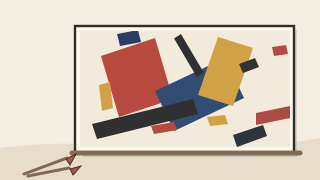
Suprematism emerged in the Russian avant-garde in 1915, using simple geometric shapes and pure color to make paintings free from recognizable subjects.
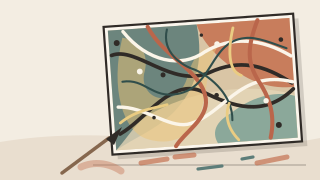
Abstract Expressionism emerged in postwar New York, where painters explored bold gestures, large canvases, and expansive fields of color.