
Oil Paint
Oil paint is a slow-drying art medium made with pigment and a drying-oil binder that allows extended working time, smooth blending, and layered application.

Painter
Victor Vasarely was a Hungarian-born French Op Art pioneer whose grids of colored shapes create illusions of bulging spheres, depth, and movement.
Vasarely turned flat repeating grids into apparent volumes through changes in square size, placement, and color; his methods helped establish Op Art.
| Born | 1906 · Pécs, Austria-Hungary (now Hungary) |
|---|---|
| Died | 1997 · Paris, France |
| Nationality | Hungarian-born French |
| Movements | Op Art |
| Paint types | Oil Paint · Acrylic Paint |
| Painting surfaces | Canvas |
| Painting methods | Regular grids distorted into curves and bulging forms, systematic color gradations, hard edges, and repeated geometric units |
| Common subjects | Squares, spheres, warped checkerboards, grids, circles, stars, and abstract spaces |
| Notable works | Vega-Nor · Vega Pâl · Opus III |
| Other work,Applied related optical systems to prints, architecture, and public art | undefined |
Sources: Buffalo AKG: Vega-Nor (1969), oil on canvas, French Ministry of Culture: Vega Pâl (1969), acrylic on canvas, Paris Musées: Opus III, acrylic painting, Museo Thyssen-Bornemisza: Victor Vasarely biography.
Vasarely's Vega-Nor is oil on canvas, while French museum catalogues document acrylic paintings including Vega Pâl and Opus III.
Oil paint is a slow-drying art medium made with pigment and a drying-oil binder that allows extended working time, smooth blending, and layered application.
Acrylic paint is a fast-drying, water-based paint made with pigment and an acrylic polymer binder. It is widely used in art and decorative projects because it is versatile and durable.
Canvas is documented for the oil painting Vega-Nor and the acrylic painting Vega Pâl; the optical effects rely on carefully organized painted forms.

Canvas is a woven fabric support, commonly cotton or linen, used for painting and sold either raw or prepared with a compatible ground layer.
Riley explored black-and-white and colored optical rhythms, while Stanczak studied precise interactions between adjacent colors.

Bridget Riley is a British painter known for abstract compositions that create optical movement through repeated lines, curves, shapes, and structured color relationships.
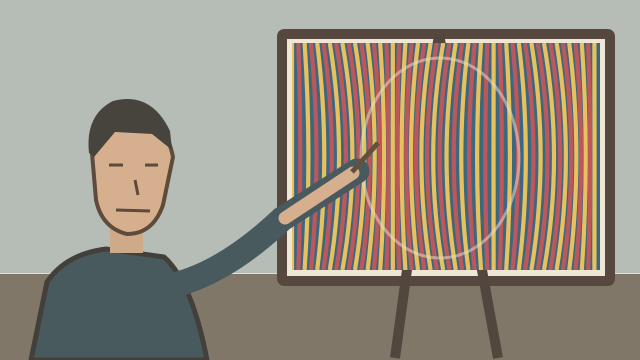
Julian Stanczak was a Polish-born American Op Art painter whose fine stripes and controlled color shifts make fixed geometric patterns seem to shimmer.