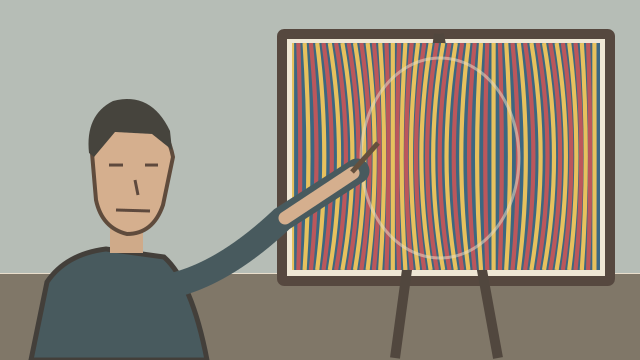
Julian Stanczak
Julian Stanczak was a Polish-born American Op Art painter whose fine stripes and controlled color shifts make fixed geometric patterns seem to shimmer.
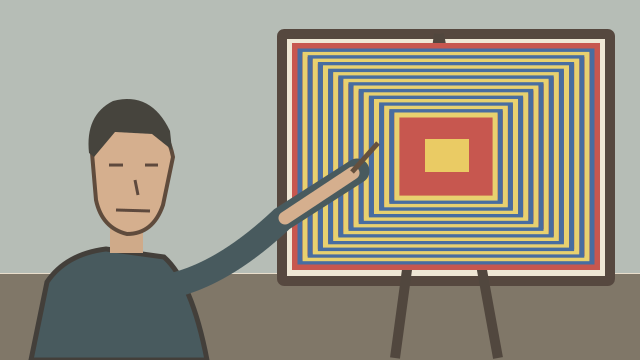
Painter
Richard Anuszkiewicz was an American Op Art painter whose radiant squares, repeated lines, and vivid complementary colors create shimmering visual effects.
Anuszkiewicz examined how brightly contrasting colors change one another's appearance, often through nested squares and repeated linear structures.
| Full name | Richard Anuszkiewicz |
|---|---|
| Born | 1930 · Erie, Pennsylvania, United States |
| Died | 2020 · Englewood, New Jersey, United States |
| Nationality | American |
| Movements | Op Art |
| Paint types | Oil Paint · Acrylic Paint |
| Other media | — |
| Other materials | — |
| Painting surfaces | Canvas · Wood · Composition board |
| Painting methods | Hard-edge nested squares, tight bands of color, complementary-color contrasts, controlled line spacing, and modular geometric arrangements |
| Common subjects | Concentric squares, radiating grids, overlapping colors, and illusionistic fields of light |
| Notable works | Water from the Rock · The Fourth of the Three · Orange Delight · Winter-Summer Reds · Temple to Albers |
Sources: Buffalo AKG: Water from the Rock (1961–63), oil on canvas, The Met: Winter-Summer Reds (1973), acrylic on canvas, Whitney: The Fourth of the Three (1963), acrylic on composition board, Buffalo AKG: Translumina II (1986), acrylic on wood construction, Smithsonian: Richard Anuszkiewicz biography.
Records identify Richard Anuszkiewicz's use of Oil paint, Acrylic paint; examples below connect the medium to named works and explain its visual role.

The Buffalo AKG records Water from the Rock (1961–63) as oil on canvas. Anuszkiewicz used controlled geometric color relationships here before acrylic works on board and canvas became central to his Op Art practice. The painting documents oil as an early medium in his exploration of optical effects.

The Whitney catalogs The Fourth of the Three as acrylic on composition board, while the Met records Winter-Summer Reds as acrylic on canvas. Repeated bands and nested forms make adjacent colors seem to vibrate, showing the medium across both a rigid panel and a flexible support.
Sources: Buffalo AKG: Water from the Rock, oil on canvas; Whitney Museum: The Fourth of the Three, acrylic on composition board; The Met: Winter-Summer Reds, acrylic on canvas; Buffalo AKG: Translumina II, acrylic on wood construction.
Richard Anuszkiewicz's documented works use canvas and wood; examples clarify whether each is the painted ground, support, or part of the object.
Anuszkiewicz’s optical paintings, including Water from the Rock and Winter-Summer Reds, are documented on canvas. He organized repeated geometric forms and carefully related colors across the flexible support, creating perceptual vibration without relying on illusionistic depth. The collection entry identifies canvas as the work’s immediate support.

He also painted on wood and composition board, as recorded for Whitney’s The Fourth of the Three. This rigid support carries nested forms and sharply bounded colors, distinct from the canvas used for his oil and acrylic works. The record identifies the panel as part of the painted construction.

Anuszkiewicz also painted on composition board, documented for The Fourth of the Three. The manufactured rigid panel gives a stable, flat surface for precisely arranged forms and repeated bands, distinguishing it from the canvas support of his other optical paintings.
Sources: Buffalo AKG: Water from the Rock (1961–63), oil on canvas, The Met: Winter-Summer Reds (1973), acrylic on canvas, Whitney: The Fourth of the Three (1963), acrylic on composition board, Buffalo AKG: Translumina II (1986), acrylic on wood construction, Smithsonian: Richard Anuszkiewicz biography.
Stanczak and Riley also manipulated line and color to create visual vibration; Anuszkiewicz often favored concentric squares and strong color contrasts.
Julian Stanczak was a Polish-born American Op Art painter whose fine stripes and controlled color shifts make fixed geometric patterns seem to shimmer.

Bridget Riley is a British painter whose abstract compositions create optical movement through repeated lines, curves, shapes, and structured color.