
Acrylic Paint
Acrylic paint is a fast-drying, water-based paint made with pigment and an acrylic polymer binder that forms a durable film on many prepared surfaces.
Painter
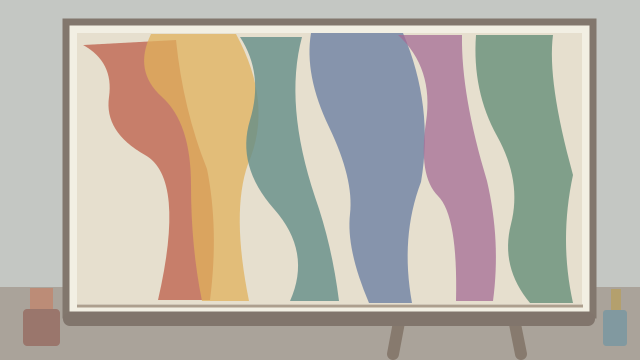
Morris Louis was an American Color Field painter known for pouring diluted Magna acrylic-resin paint onto raw canvas to produce luminous Veils, Unfurleds, and Stripes.
Louis's mature works relied on Magna, a solvent-thinned acrylic resin paint, and absorbent raw cotton canvas. Unlike standard waterborne acrylic paints, Magna could be diluted with turpentine or resin medium.
| Born | November 28, 1912 · Baltimore, Maryland, U.S. |
|---|---|
| Died | September 7, 1962 · Washington, D.C., U.S. |
| Nationality | American |
| Movements | Color Field Painting · Washington Color School · Post-Painterly Abstraction |
| Paint types | Magna solvent-based acrylic-resin paint (related to, but chemically different in handling from ordinary waterborne acrylic paint) |
| Painting surfaces | Unprimed cotton canvas, usually painted unstretched |
| Painting methods | Poured fluid Magna onto unstretched, unprimed cotton canvas; tilted or folded the fabric to direct transparent color as it soaked into the weave |
| Common subjects | Nonrepresentational flowing veils, diagonal Unfurled streams, upright Stripes, and large areas of exposed raw canvas |
| Notable works | Intrigue (1954) · Tet (1958) · Alpha-Pi (1960) |
Sources: The Met: Alpha-Pi and Magna on canvas, Smithsonian Hirshhorn: Morris Louis and Magna, Princeton Art Museum: Intrigue and pouring technique, Whitney: Tet and stain technique, Saint Louis Art Museum: artist biography.
The Met and Smithsonian document Magna, a solvent-based acrylic resin paint, as Louis's mature medium; his estate describes it as the only acrylic paint he used. The acrylic-paint tile below introduces the related binder family, but ordinary waterborne acrylic is not a historical substitute for Magna or evidence of its use by Louis.
Acrylic paint is a fast-drying, water-based paint made with pigment and an acrylic polymer binder that forms a durable film on many prepared surfaces.
Louis poured onto unstretched, unprimed cotton canvas so the diluted Magna penetrated the fibers. The raw weave and its absorbency were part of the effect; he commonly stretched the canvas only after the paint dried.

Canvas is a woven fabric support, commonly cotton or linen, used for painting and sold either raw or prepared with a compatible ground layer.
Frankenthaler's early soak-stain work helped inspire Louis, while Newman's broad, nonrepresentational color fields offer a contrasting approach to postwar abstraction.

Helen Frankenthaler was an American painter whose soak-stain technique helped reshape postwar abstraction by allowing thinned paint to soak directly into raw canvas.
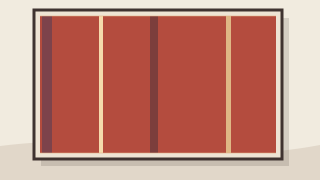
Barnett Newman was an American abstract painter known for vast, often monochromatic color fields interrupted by narrow vertical stripes he called zips.