
Oil Paint
Oil paint is a slow-drying art medium made with pigment and a drying-oil binder that allows extended working time, smooth blending, and layered application.
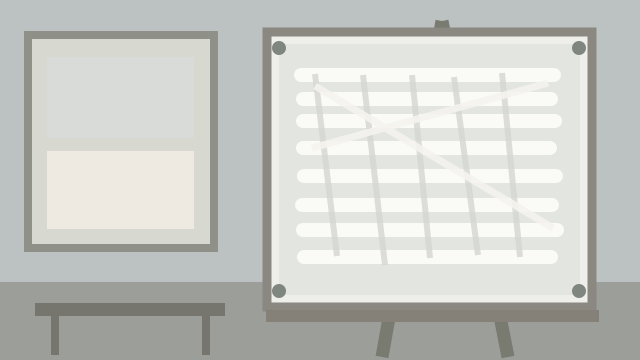
Painter
Robert Ryman was an American painter known for exploring the physical behavior of mostly white paint on different supports, with brushstrokes, surfaces, and mounting hardware as visible parts of the work.
Although associated with Minimalism, Ryman emphasized what paint actually does rather than illustrating a fixed geometric idea. His works use different paints and supports, including linen canvas and industrial fiberglass panels.
| Born | 1930 · Nashville, Tennessee, U.S. |
|---|---|
| Died | 2019 · New York City, New York, U.S. |
| Nationality | American |
| Movements | Minimalism (frequently associated); monochrome and material-focused abstraction |
| Paint types | Oil paint · enamel paint · latex paint · gouache (documented 1961 work on paper) |
| Painting surfaces | Canvas and linen · fiberglass · paper (gouache work) |
| Painting methods | Varied paint, primer, and brushstroke thickness, sometimes exposing underlying colors; experimented with unstretched fabrics, fiberglass panels, fasteners, and attachment to the wall |
| Common subjects | White and near-white painted surfaces, square formats, edges, paint texture, and the physical presentation of painting itself |
| Notable works | To Kirk Varnedoe (1961) · Record (1983) · Versions IV (1992) |
Sources: Whitney: Robert Ryman materials overview, MoMA: Record (oil/enamel on fiberglass), MoMA: To Kirk Varnedoe (oil on linen), MoMA: 1961 gouache on paper, The Met: Versions IV.
MoMA describes Record (1983) as oil and enamel on fiberglass and catalogs a 1961 gouache work on paper. The Whitney documents oil, enamel and latex across Ryman's wider practice. These are separate documented uses, not interchangeable formulations.
Oil paint is a slow-drying art medium made with pigment and a drying-oil binder that allows extended working time, smooth blending, and layered application.
Enamel paint is a broad coating category formulated to produce a durable finish, with modern products available in both oil-based and water-based systems.
Latex paint is a water-based architectural coating made with a synthetic polymer binder and commonly used on interior and exterior building surfaces.

Gouache paint is an opaque, water-based art medium made with pigment and a water-soluble binder, drying to a matte finish that can be reactivated with water.
MoMA documents oil on unstretched linen for his 1961 painting To Kirk Varnedoe and oil/enamel on fiberglass for Record. Separate gouache drawings used paper. Metal screws and fasteners may be visible but are not always paint-bearing supports.

Canvas is a woven fabric support, commonly cotton or linen, used for painting and sold either raw or prepared with a compatible ground layer.

Fiberglass is a composite of glass fibers embedded in resin, with finished parts usually presenting a smooth resin or gelcoat surface rather than exposed fibers.

Paper is an absorbent sheet material made from pressed fibers, with weight, sizing, and surface texture controlling moisture tolerance and paint behavior.
Martin also investigated restrained abstract painting through grids, while Baer used bands and edges to foreground the painting as an object in the viewer's space.
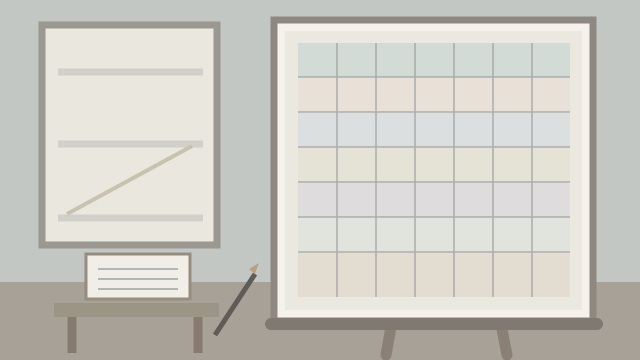
Agnes Martin was a Canadian-born American painter known for quiet abstract grids and stripes, delicate pencil lines, and softly colored canvases.
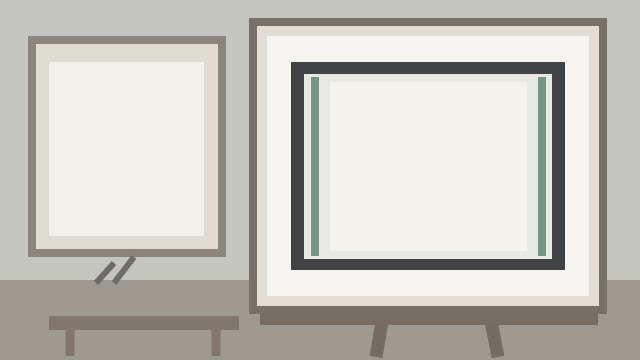
Jo Baer was an American painter known for sharply defined Minimalist canvases with slim color bands near their edges and for a later return to figurative imagery.