
Paint Type
Egg Tempera
Egg tempera is a traditional paint made from pigment, egg yolk, and water that dries quickly in thin layers on a rigid, smooth, absorbent ground.
Egg tempera surface compatibility
Egg tempera suits rigid panels with a smooth, absorbent ground; flexible supports can move enough to stress or crack its relatively brittle paint layers.
| Surface | Compatibility | Preparation | Primer or ground | Finish | Guide |
|---|---|---|---|---|---|
| Painting Board | Excellent when the board is rigid and prepared for egg tempera | Use a clean, stable, rigid board and make the surface as smooth and even as the chosen technique requires. | Traditional gesso or a purpose-made tempera ground. | Build the painting in thin layers and allow it to mature fully before any optional protective treatment. | — |
| Wood Panel | Excellent when rigid, stable, and properly grounded | Use a well-seasoned, stable panel and prepare it to receive a smooth tempera ground. | Traditional gesso or another ground specifically suitable for egg tempera. | Apply thin layers rather than a heavy flexible paint film; final protection is optional and technique-specific. | — |
Sources: Natural Pigments comparison of tempera grounds, Kremer Pigmente tempera recipe, and Sennelier Egg Tempera.
Painters who used egg tempera
PaintZeal's painter profiles document egg tempera practice through thin layers, rigid supports, and specific works that show how artists used the medium.
-
Andrew Wyeth
Brandywine records Wyeth’s egg tempera paintings on panel, a rigid support suited to his thin, controlled layers. He learned the technique from Peter Hurd and used it to render coastal and rural subjects with closely observed detail.
-

George Tooker
The Met identifies Government Bureau (1956) as egg tempera on wood. Tooker’s slow, layered process lets the white gesso glow through thin paint, sharpening the enclosed rooms and quiet social unease that recur in his work.
-

Paul Cadmus
Cadmus worked chiefly in egg tempera, building precisely drawn figures with small, controlled strokes. His carefully staged scenes use that clarity to combine classical technique with pointed observation of modern social life and crisp surface finish.
-

Koo Schadler
Schadler prepares egg tempera from pigment, egg yolk, and water, applying small strokes over traditional gesso panels. Her painting and teaching carry forward a layered method that rewards patient, precise handling of color and detail.
-
Reginald Marsh
The Smithsonian catalogs Marsh’s Coney Island Beach (ca. 1953) as egg tempera and ink on fiberboard. Its packed figures and restless beach crowd show how he used a crisp, controlled panel technique to capture New York leisure and street life.
-
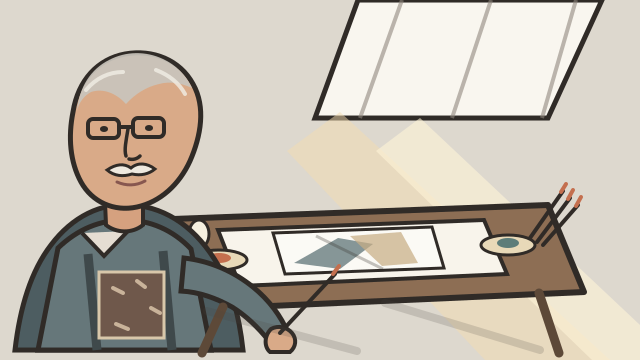
Robert Vickrey
The Smithsonian records Vickrey’s Fear (1954) as egg tempera on paperboard. He used the medium’s precision for meticulously observed scenes, where sharply rendered objects and figures heighten symbolic tension across the flat support. The entry specifies egg tempera and identifies the paperboard surface.
-

Peter Hurd
New Mexico Museum records Hurd’s Rio Hondo as egg tempera on gesso over wood panel. He used the rigid support and thin paint layers to describe Southwestern terrain, clear light, and weather with the close observation that defines his landscapes.
-

Mavis Smith
Smith often paints in egg tempera, a medium she values for intricate detail and luminous layered color. Her portraits and still lifes build translucent passages into carefully finished surfaces, extending the traditional technique in contemporary subjects.
-

Jared French
French favored egg tempera, using small brushstrokes to build precise forms and hard clarity of edge and surface. That controlled technique gives his staged figure scenes their still, sharply bounded quality, as seen in works such as Murder.
-

Fred Wessel
Wessel paints Renaissance-inspired portraits and still lifes in egg tempera on prepared panels, often adding gold leaf. His technique draws on Cennini’s instructions and uses a green underpainting to build warm, finely modeled flesh tones.
-

Michael Bergt
Nuart describes Bergt as primarily an egg-tempera painter, working with layered color on panels. His mythological figures are carefully modeled and often incorporate acrylic or gold leaf, combining precise draftsmanship with contemporary subject matter in carefully finished compositions.
-

Sandro Botticelli
Scientific analysis of Botticelli’s Lamentation of Christ detected egg yolk in its paint binder. The evidence connects his Florentine panel painting to egg tempera’s fine layering, which supports the crisp contours and delicate color associated with his Renaissance compositions.
Sources: Koo Schadler, History of Egg Tempera; Smithsonian American Art Museum, Modern American Realism; New Mexico Museum of Art, Rio Hondo; Mavis Smith, About; Fred Wessel, Technique; Nuart Gallery, Michael Bergt; Scientific analysis of Botticelli’s painting materials.
Egg tempera articles
PaintZeal has no dedicated egg tempera articles yet, so this guide covers its binder, rigid supports, absorbent grounds, and painting layers.