
Emulsion Paint
Emulsion paint is a common UK term for water-based paint used on interior walls and ceilings. Most modern formulas use an acrylic or vinyl binder and dry to a durable finish.

Painter
Lucia Di Luciano is an Italian artist associated with Arte Programmata and mathematically structured geometric abstraction, including works made with household emulsion, acrylic, and tempera paint.
Di Luciano worked within Arte Programmata, using mathematical structures and optical effects related to Op Art, while experimenting with emulsion, acrylic, and tempera paint.
| Born | 1933 · Syracuse, Italy |
|---|---|
| Died | January 4, 2026 · Rome, Italy |
| Nationality | Italian |
| Practice | Geometric and mathematically structured abstraction |
| Paint types | Emulsion paint · Acrylic paint · Tempera |
| Painting surfaces | Masonite · Paper · Cardboard · Canvas · Fabric |
| Painting methods | Programmed compositions built from mathematical permutations and rhythmic geometric modules |
| Common subjects | Geometric forms, grids, mathematical permutations, rhythm, and optical structure |
| Movements | Arte Programmata |
| Notable works | Discontinuous Structural Articulation · 4 Gruppi di immagini in combinatoria intersecati da immagini in ripetizione · Cromo struttura N.2 |
Sources: Tate: Discontinuous Structural Articulation, 10 A.M. ART: Lucia Di Luciano, and 10 A.M. ART: Works from the 60s to 2024.
See the paint types documented in Di Luciano's work, with links to PaintZeal references explaining each medium's properties, uses, and working characteristics.
Emulsion paint is a common UK term for water-based paint used on interior walls and ceilings. Most modern formulas use an acrylic or vinyl binder and dry to a durable finish.

Acrylic paint is a fast-drying, water-based paint made with pigment and an acrylic polymer binder. It is widely used in art and decorative projects because it is versatile and durable.

Traditional tempera is an artist paint made by combining pigment with an emulsion binder. Egg yolk is the best-known traditional binder, but the broader tempera category can include other emulsion recipes, so a museum record that says only “tempera” does not always identify the exact binder.
See the surface types documented in Di Luciano's work, with links to PaintZeal references explaining how each support behaves and is prepared for painting.

Painting board is a rigid artist support made from hardboard, wood, or another stable panel material. It may be sold raw or prepared with a medium-specific ground layer.

Paper is an absorbent sheet material made primarily from cellulose fibers. Its weight, sizing, surface texture, and wet strength determine how much paint it can accept before buckling, pilling, bleeding, or warping.

Cardboard is a paper-based sheet material made from compressed fibers, often with corrugated fluting between liner sheets. It is lightweight and absorbent, so heavy wet coats can soften or warp it.
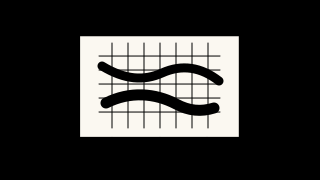
Canvas is a woven fabric support used for paintings, banners, bags, décor, and other projects. Artist canvas may be raw, sized, acrylic-primed, oil-primed, or factory-coated, and each condition changes how paint absorbs and bonds.

Fabric is a flexible material made by weaving, knitting, or bonding fibers. Its fiber content, texture, stretch, and washability affect how paint bonds and wears.
Explore painters similar to Lucia Di Luciano through geometric abstraction, optical systems, rigid supports, emulsion paint, and mathematically structured compositions.

Bridget Riley is a British painter known for abstract compositions that create optical movement through repeated lines, curves, shapes, and structured color relationships.

Peter Halley is an American painter known for geometric images of cells, prisons, and conduits built from fluorescent Day-Glo acrylic color and deliberately artificial commercial textures.

Frank Stella was an American artist known for abstract painting and extensive use of industrial coatings, including alkyd, epoxy, urethane, fluorescent, and antifouling paints.