
Oil Paint
Oil paint is a slow-drying paint made with pigment and a drying oil binder. It is widely used for artwork because it blends smoothly and develops rich color.
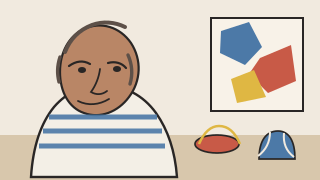
Painter
Pablo Picasso was a Spanish artist whose long career moved through many styles and media, from the Blue and Rose periods to Cubism, classicism, Surrealism, sculpture, printmaking, and ceramics.
Review key details about Pablo Picasso's life, career, nationality, major periods, and the artistic movements that shaped his long and varied practice.
| Full name | Pablo Ruiz Picasso |
|---|---|
| Born | October 25, 1881 · Málaga, Spain |
| Died | April 8, 1973 · Mougins, France |
| Nationality | Spanish |
| Movements | Cubism, modernism, and Surrealism |
| Paint types | Oil paint · Acrylic paint · Enamel paint · Gouache · Watercolor |
| Painting surfaces | Canvas · Paper · Cardboard · Wood · Ceramic |
| Painting methods | Rapidly reworked, layered painting combined with Cubist fragmentation, drawing, and collage |
| Other media | Drawing, collage, sculpture, printmaking, ceramics, stage design, and assemblage |
| Common subjects | Portraits, figures, still lifes, musicians, interiors, war, mythology, and the artist's studio |
| Notable works | Les Demoiselles d'Avignon, Guernica, Girl before a Mirror, and Three Musicians |
Sources: Musée national Picasso-Paris timeline, The Museum of Modern Art, MoMA: Les Demoiselles d'Avignon, MoMA: Self Portrait (Yo), MoMA: study in gouache and watercolor, Musée national Picasso-Paris: The Fall of Icarus, MoMA: Seated Woman, and Smithsonian Museum Conservation Institute: Picasso enamel-paint research.
See the paint types documented in Picasso's work, with links to PaintZeal references explaining each medium's properties, uses, and working characteristics.
Oil paint is a slow-drying paint made with pigment and a drying oil binder. It is widely used for artwork because it blends smoothly and develops rich color.

Acrylic paint is a fast-drying, water-based paint made with pigment and an acrylic polymer binder. It is widely used in art and decorative projects because it is versatile and durable.

Enamel paint is a broad category of coatings designed to form a hard and durable finish. Modern enamels may use either oil-based or water-based binders.

Gouache paint is an opaque, water-based art medium made with pigment and a water-soluble binder. Traditional formulas dry to a matte finish and can be reactivated with water.
Watercolor paint is a water-based art medium made with pigment and a water-soluble binder. It is known for transparent color that settles into absorbent paper.
See the surface types documented in Picasso's work, with links to PaintZeal references explaining how each support behaves and is prepared for painting.
Canvas is a woven fabric support used for paintings, banners, bags, décor, and other projects. Artist canvas may be raw, sized, acrylic-primed, oil-primed, or factory-coated, and each condition changes how paint absorbs and bonds.

Paper is an absorbent sheet material made primarily from cellulose fibers. Its weight, sizing, surface texture, and wet strength determine how much paint it can accept before buckling, pilling, bleeding, or warping.

Cardboard is a paper-based sheet material made from compressed fibers, often with corrugated fluting between liner sheets. It is lightweight and absorbent, so heavy wet coats can soften or warp it.
Wood is a natural, porous material with grain patterns and absorbency that vary by species and cut. Its surface may also contain knots, resin, or an existing finish.

Ceramic is a fired clay material used for pottery, tiles, dishes, décor, and architectural finishes. Unglazed ceramic is porous and absorbent, while glazed ceramic has a hard glass-like surface that gives ordinary paint little mechanical grip.
Explore painters similar to Pablo Picasso through modernist experimentation, bold approaches to form, and work spanning painting, collage, sculpture, and printmaking.
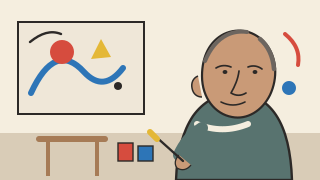
Joan Miró was a Spanish artist associated with Surrealism, known for biomorphic forms, symbolic imagery, vivid color, and abstract compositions across painting and printmaking.
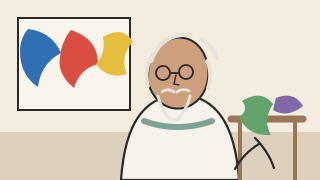
Henri Matisse was a French artist known for vivid color, simplified forms, Fauvist painting, and the gouache-painted paper cut-outs of his later career.