
Oil Paint
Oil paint is a slow-drying art medium made with pigment and a drying-oil binder that allows extended working time, smooth blending, and layered application.
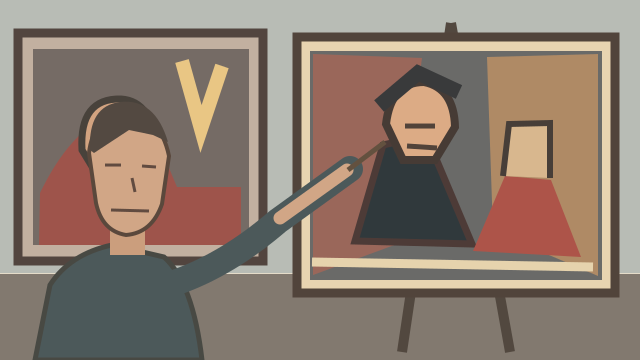
Painter
Max Beckmann was a German painter whose forceful portraits, crowded interiors, mythic triptychs, and heavy black contours explored modern uncertainty.
Beckmann used forceful outlines and compressed spaces in portraits and allegories, including a major triptych painted on three canvases.
| Born | 1884 · Leipzig, German Empire (now Germany) |
|---|---|
| Died | 1950 · New York City, United States |
| Nationality | German |
| Movements | New Objectivity (associated); Expressionism (often grouped) |
| Paint types | Oil Paint · Gouache Paint · Watercolor Paint |
| Painting surfaces | Canvas |
| Painting methods | Strong black outlines, compressed perspective, sharply bounded color, and narrative figures arranged across triptych panels |
| Common subjects | Self-portraits, cabarets, performers, city interiors, biblical scenes, political violence, and mythological allegories |
| Notable works | Self-Portrait with a Cigarette · Departure · The Feast of the Prodigal Son |
| Other supports | Gouache and watercolor over drawn details on parchment in his c. 1918 Prodigal Son series |
Sources: Städel Museum: Max Beckmann biography, MoMA: Self-Portrait with a Cigarette, oil on canvas, MoMA: Departure, oil on canvas triptych, MoMA: The Feast of the Prodigal Son, gouache and watercolor on parchment.
Beckmann painted large oils on canvas and used gouache and watercolor over ink and pencil in smaller narrative works on parchment.
Oil paint is a slow-drying art medium made with pigment and a drying-oil binder that allows extended working time, smooth blending, and layered application.

Gouache paint is an opaque, water-based art medium made with pigment and a water-soluble binder, drying to a matte finish that can be reactivated with water.

Watercolor paint is a water-based art medium made with pigment and a water-soluble binder, typically applied in transparent washes on absorbent paper.
MoMA documents oil paintings and the three-panel Departure on canvas; gouache and watercolor were also used on parchment.

Canvas is a woven fabric support, commonly cotton or linen, used for painting and sold either raw or prepared with a compatible ground layer.
Dix and Grosz also confronted the conflicts of Weimar Germany, while Beckmann developed a more personal and allegorical visual language.
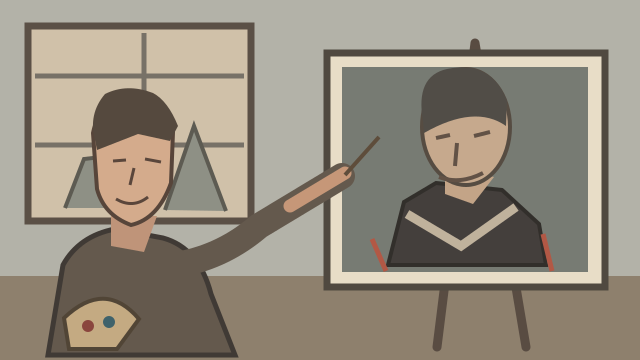
Otto Dix was a German painter associated with New Objectivity, known for sharp Weimar-era portraits, war imagery, and unsettling depictions of modern life.
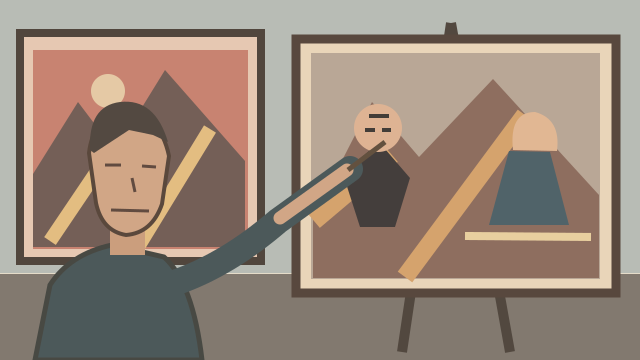
George Grosz was a German-American painter known for savage satire, sharply observed Weimar-era portraits, urban scenes, and expressive works on paper.