
Expressionism
Expressionism grew in early twentieth-century Germany and Austria, using distorted forms, intense color, and bold compositions to express emotional experience.

Painting Movement
New Objectivity developed in 1920s Germany as painters turned to unsentimental portraits and sharp observations of life during the Weimar Republic.
Its painters combined precise observation with psychological tension, often portraying a society shaped by war, inequality, and political upheaval.
| Origin | Germany during the Weimar Republic |
|---|---|
| Approximate period | 1920s–early 1930s |
| German name | Neue Sachlichkeit, meaning “New Objectivity” or “New Matter-of-Factness” |
| Naming milestone | Gustav Friedrich Hartlaub's 1925 exhibition Neue Sachlichkeit in Mannheim |
| Movement structure | A critical grouping of artists working in several German cities, not a single formally organized school |
| Defining characteristics | Sharp observation, detailed figuration, cool presentation, social criticism, and sometimes grotesque satire |
| Common subjects | Portraits, city life, veterans, social tensions, nightlife, and Weimar-era professions |
| Leading painters | Otto Dix, George Grosz, Max Beckmann, and Christian Schad |
| Stylistic variety | Harsh social satire and cool, classical-looking portraits both appeared within the broader label |
| Relationship to Expressionism | Partly a reaction against subjective distortion, although artists and ideas overlapped across the two movements |
| Political context | Social consequences of World War I and the upheavals of Weimar Germany |
| Paint medium | Oil paint, among others; artists also made significant drawings and prints |
| Painting surfaces | Canvas and other supports depending on artist and medium |
Sources: MoMA: New Objectivity, MoMA: German Expressionism and New Objectivity, and The Met: German Drawings and Prints from the Weimar Republic.
Dix examined war and German society with unsettling precision, Grosz used cutting satire, and Beckmann painted psychologically intense portraits.
| Painter | Known for | Representative painting |
|---|---|---|
| Otto Dix | Unflinching portraits, veterans, and the impact of World War I | Dr. Mayer-Hermann (1926) |
| George Grosz | Satirical depictions of politics, inequality, and urban life | The Poet Max Herrmann-Neisse (1927) |
| Max Beckmann | Stark portraiture and charged scenes of modern life | Self-Portrait with a Cigarette (1923) |
| Christian Schad | Cool, meticulously rendered portraits of contemporary society | Sonja (1928) |
Sources: MoMA: New Objectivity, selected works, MoMA: Dr. Mayer-Hermann, and MoMA: New Objectivity in German art.
New Objectivity challenged Expressionist distortion through a more matter-of-fact style, but its realism often carried sharp criticism.
Expressionism grew in early twentieth-century Germany and Austria, using distorted forms, intense color, and bold compositions to express emotional experience.
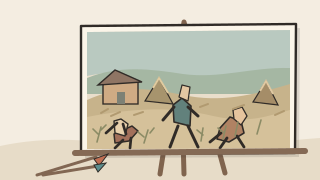
Realism emerged in nineteenth-century France as painters depicted ordinary people, rural labor, and contemporary life without idealization or heroic subjects.
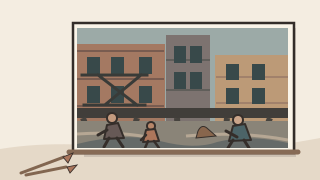
The Ashcan School was an American art movement known for lively, unsentimental depictions of everyday city life, especially in early twentieth-century New York.