
Oil Paint
Oil paint is a slow-drying art medium made with pigment and a drying-oil binder that allows extended working time, smooth blending, and layered application.
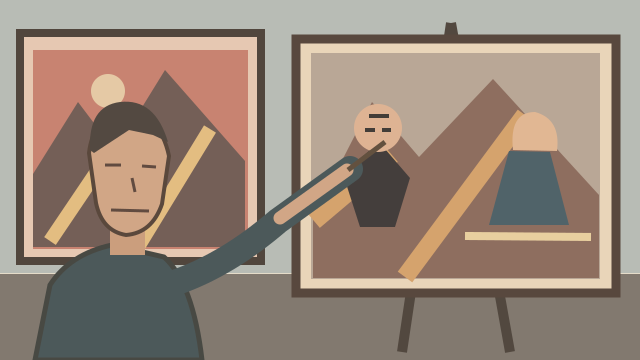
Painter
George Grosz was a German-American painter known for savage satire, sharply observed Weimar-era portraits, urban scenes, and expressive works on paper.
Grosz used caricature and exacting observation to depict Berlin society; he also painted less satirical landscapes after moving to the United States.
| Born | 1893 · Berlin, German Empire (now Germany) |
|---|---|
| Died | 1959 · Berlin, Germany |
| Nationality | German-American |
| Movements | New Objectivity; Dada |
| Paint types | Oil Paint · Watercolor Paint · Gouache Paint |
| Painting surfaces | Canvas · Paper |
| Painting methods | Incisive ink contours, careful portrait modeling, watercolor washes, opaque gouache passages, and densely observed urban figures |
| Common subjects | Politicians, cabarets, war veterans, Berlin street scenes, writers, social inequality, and later American landscapes |
| Notable works | The Poet Max Herrmann-Neisse · Self-Portrait with a Model · Explosion · Dune Country, Cape Cod |
| Other supports | Oil on board is documented for the 1917 painting Explosion; the board composition is unspecified |
Sources: The Met: Berlin Street, oil on canvas, MoMA: The Poet Max Herrmann-Neisse, oil on canvas, MoMA: Punishment, watercolor and opaque watercolor on paper, The Met: Dune Country, Cape Cod, watercolor and gouache on paper, MoMA: Explosion, oil on board.
Grosz painted portraits and scenes in oil while using both transparent watercolor and opaque gouache for satirical and landscape works on paper.
Oil paint is a slow-drying art medium made with pigment and a drying-oil binder that allows extended working time, smooth blending, and layered application.

Watercolor paint is a water-based art medium made with pigment and a water-soluble binder, typically applied in transparent washes on absorbent paper.

Gouache paint is an opaque, water-based art medium made with pigment and a water-soluble binder, drying to a matte finish that can be reactivated with water.
Collection records document oils on canvas and watercolor or gouache on paper; a separate early oil is cataloged simply as on board.

Canvas is a woven fabric support, commonly cotton or linen, used for painting and sold either raw or prepared with a compatible ground layer.

Paper is an absorbent sheet material made from pressed fibers, with weight, sizing, and surface texture controlling moisture tolerance and paint behavior.
Dix and Beckmann also portrayed Weimar-era Germany with unsettling precision, though their subjects and painting methods differed.
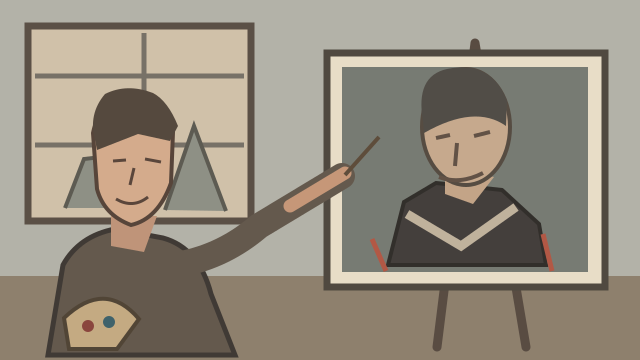
Otto Dix was a German painter associated with New Objectivity, known for sharp Weimar-era portraits, war imagery, and unsettling depictions of modern life.
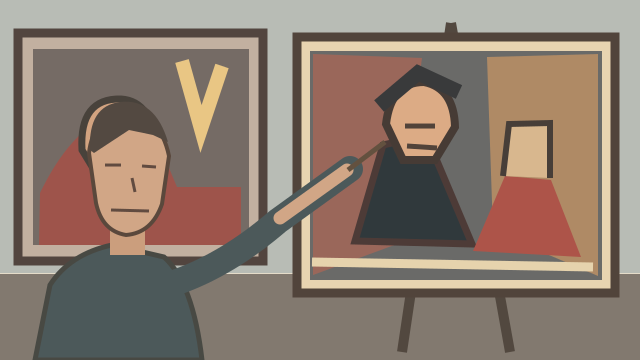
Max Beckmann was a German painter whose forceful portraits, crowded interiors, mythic triptychs, and heavy black contours explored modern uncertainty.