Oil Paint
Oil paint is a slow-drying paint made with pigment and a drying oil binder. It is widely used for artwork because it blends smoothly and develops rich color.
Painter
Marc Chagall was a Belarus-born French artist known for dreamlike scenes combining village memories, lovers, animals, folklore, religion, music, and vivid color.
Review key details about Marc Chagall's life, career, European and French context, major periods, and the folklore, religion, music, and memory shaping his work. His early Paris paintings drew on Cubism, while his dreamlike imagery anticipated Surrealism without making him a member of that movement.
| Born | July 7, 1887 · Liozna, Russian Empire, near present-day Vitebsk, Belarus |
|---|---|
| Died | March 28, 1985 · Saint-Paul-de-Vence, France |
| Nationality | French, born in present-day Belarus |
| Movements | Modernism and the School of Paris |
| Paint types | Oil paint · Watercolor · Gouache · Tempera · Glass painting (grisaille) |
| Painting surfaces | Canvas · Linen · Paper · Painting board · Cardboard · Glass |
| Painting methods | Layered translucent color masses and fluid outlines, later informed by stained-glass grisaille and lead-line structure |
| Other media | Drawing, printmaking, stained glass, mosaic, ceramics, and stage design |
| Common subjects | Village life, lovers, animals, musicians, biblical imagery, dreams, and memory |
| Notable works | I and the Village, Birthday, Calvary, and the Aleko stage designs |
Sources: The Museum of Modern Art, MoMA: I and the Village, MoMA: Birthday, The Met: Snow, Winter in Vitebsk, National Gallery of Art, Tretyakov Gallery Magazine: Interior with Flowers, Centre Pompidou: Résistance, and Marc Chagall official archive: glass.
See the paint types documented in Chagall's work, with links to PaintZeal references explaining each medium's properties, uses, and working characteristics.
Oil paint is a slow-drying paint made with pigment and a drying oil binder. It is widely used for artwork because it blends smoothly and develops rich color.
Watercolor paint is a water-based art medium made with pigment and a water-soluble binder. It is known for transparent color that settles into absorbent paper.
Gouache paint is an opaque, water-based art medium made with pigment and a water-soluble binder. Traditional formulas dry to a matte finish and can be reactivated with water.

Traditional tempera is an artist paint made by combining pigment with an emulsion binder. Egg yolk is the best-known traditional binder, but the broader tempera category can include other emulsion recipes, so a museum record that says only “tempera” does not always identify the exact binder.
Glass paint is a specialty coating formulated to adhere to smooth glass and similar glazed surfaces. Products may be opaque or transparent and can use air curing, oven curing, or another product-specific process to improve durability.
See the surface types documented in Chagall's work, with links to PaintZeal references explaining how each support behaves and is prepared for painting.
Canvas is a woven fabric support used for paintings, banners, bags, décor, and other projects. Artist canvas may be raw, sized, acrylic-primed, oil-primed, or factory-coated, and each condition changes how paint absorbs and bonds.

Linen is a strong woven fabric made from flax fibers and commonly used as a support for fine-art painting. Artist linen may be sold raw or prepared with a ground layer.
Paper is an absorbent sheet material made primarily from cellulose fibers. Its weight, sizing, surface texture, and wet strength determine how much paint it can accept before buckling, pilling, bleeding, or warping.

Painting board is a rigid artist support made from hardboard, wood, or another stable panel material. It may be sold raw or prepared with a medium-specific ground layer.

Cardboard is a paper-based sheet material made from compressed fibers, often with corrugated fluting between liner sheets. It is lightweight and absorbent, so heavy wet coats can soften or warp it.
Glass is a hard, smooth, nonporous material with very low absorbency and limited mechanical grip for paint. Fingerprints, soap film, polish, dust, and other invisible residues can also interfere with adhesion.
Explore painters similar to Marc Chagall through vivid color, modernist experimentation, symbolic imagery, dreamlike forms, and work spanning several artistic media.
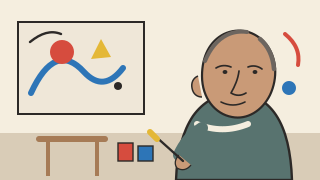
Joan Miró was a Spanish artist associated with Surrealism, known for biomorphic forms, symbolic imagery, vivid color, and abstract compositions across painting and printmaking.
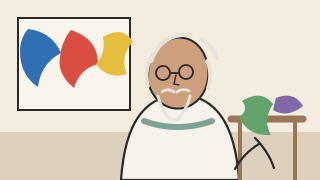
Henri Matisse was a French artist known for vivid color, simplified forms, Fauvist painting, and the gouache-painted paper cut-outs of his later career.
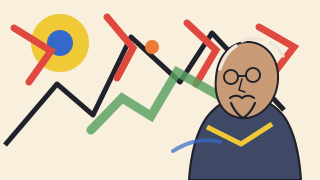
Wassily Kandinsky was a Russian-born painter, teacher, and theorist known for abstract compositions exploring relationships among color, line, shape, and rhythm.